The Return of the Native
London: Macmillan and Co., Limited, 1929.
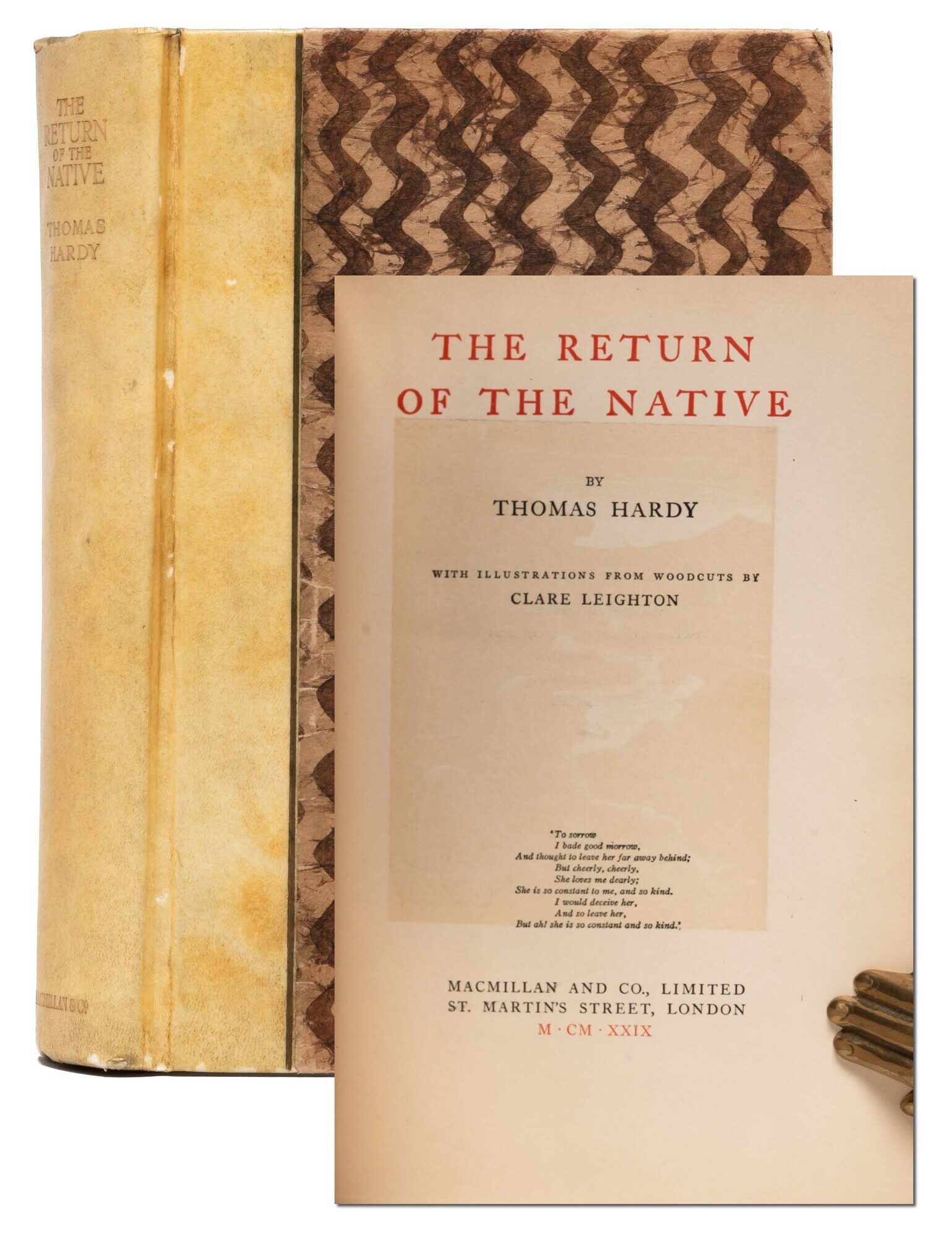
The Return of the Native
London: Macmillan and Co., Limited, 1929. Signed limited edition. One of 1,500 copies signed by the illustrator. Leaves measuring 230 x 160 mm. xvi, 485 pp. Illustrated with twelve plates (including frontispiece) by Clare Leighton. A Very Good copy. Publisher's quarter imitation vellum over decorative paper boards. Some abrasion to spine and some edgewear. Top edge gilt. Some toning to endpapers. Evidence of removed bookplate at upper pastedown. Offsetting to title-page from frontispiece. Otherwise, clean throughout.
When The Return of the Native was first published in 1878, it was met with some scandal due to Hardy's open acknowledgement of sexuality and the flawed characters that populate the novel, particularly Eustacia Vye. In the twentieth century, however, the novel gained new popularity and became one of Hardy's most appreciated titles, alongside Tess of the D'Urbervilles and Far from the Madding Crowd. This edition is ornamented with woodcuts by the artist Clare Leighton (1898 – 1989), best known for her illustrations of rural England in the 1920s and 30s and for illustrating a celebrated edition of Thornton Wilder's The Bridge of San Luis Rey (1929). She was also the first woman to produce a book on wood engraving – her Wood-Engraving and Woodcuts (1932) helped popularize the medium among a twentieth-century audience. Very Good (Item #8280)