
The Thousand and One Nights, commonly called...the Arabian Nights' Entertainments (in 3 vols.)
London: Charles Knights and Co., 1839-1841.
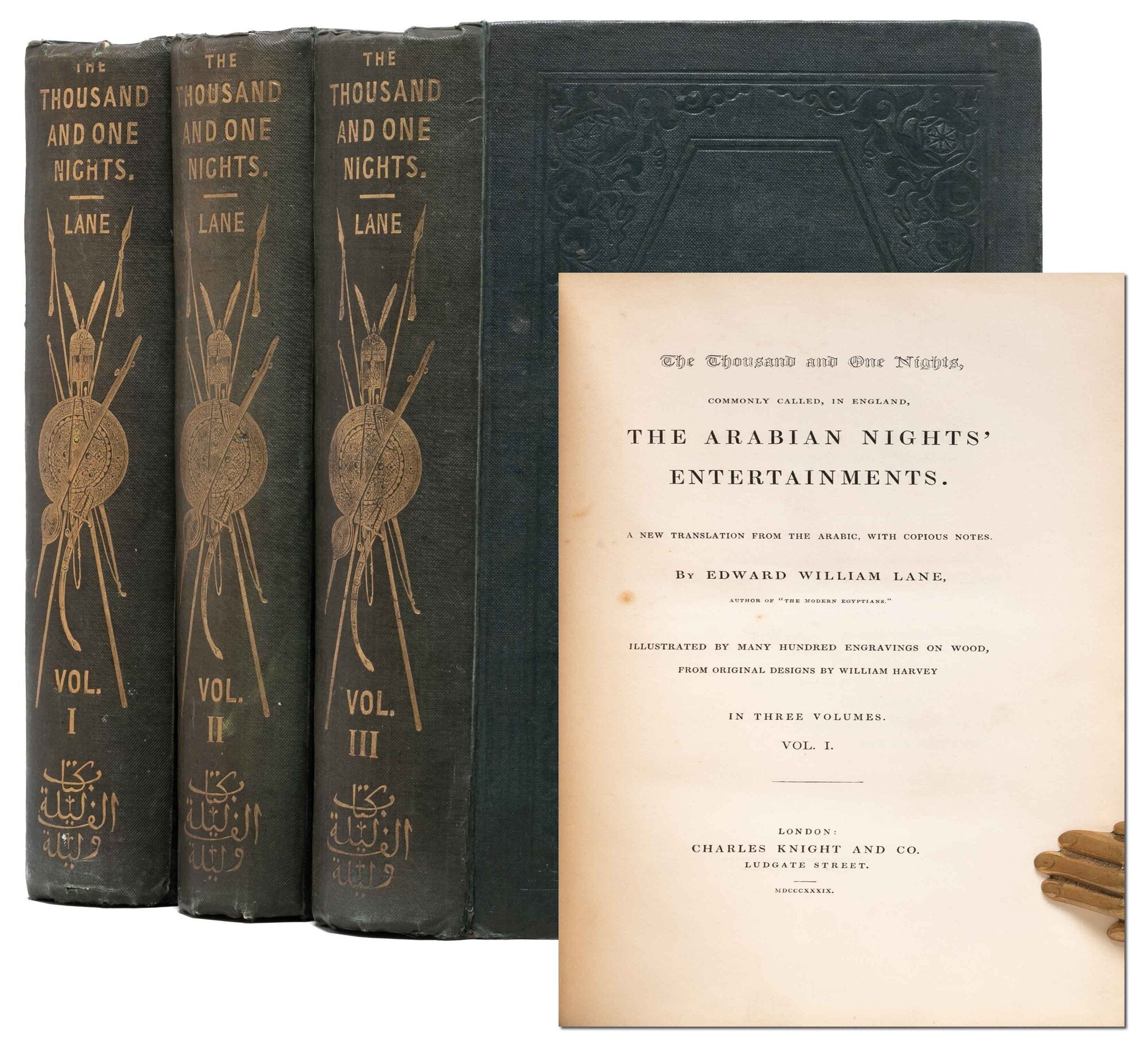
The Thousand and One Nights, commonly called...the Arabian Nights' Entertainments (in 3 vols.)
London: Charles Knights and Co., 1839-1841. First thus. First edition of Lane's translation, the first English translation done directly from the Arabic. Three volumes, octavo (leaves measuring 250 x 160 mm). xxxii, 618; xii, 643; xii, 763 pp. With engraved titles and hundreds of woodcuts by William Harvey. A Very Good set. Publisher's green cloth stamped in gilt and blind. Some fading to spines. Yellow coated endpapers. Expert tissue reinforcement to inner hinges of two volumes. Contemporary bookplate of English surgeon and dermatologist Erasmus Wilson (1809 - 1884) to upper pastedowns of volumes one and two, as well as corresponding ink gift inscriptions ("To my dearest wife Charlotte Mary Wilson, April 6th 1842, E.W.") and another set of nineteenth-century ink initials to upper free endpapers. Evidence of detached bookplate to upper pastedown of volume three. Small ink stain to two pages in volume two, otherwise quite clean throughout. An appealing example of this richly illustrated edition.
The Thousand and One Nights (Alf Laylah wa-Laylah), also referred to as the Arabian Nights, is a collection of folktales drawn from diverse sources across Southwest Asia and North Africa, mostly originating from the Abbasid Caliphate (ca. 750 - 1250). Persian and Arabic manuscript versions compiling at least some of the tales date back to the eleventh century, and Antoine Galland, who published the first translation of the Nights into a European language between 1704 and 1717, worked from a fifteenth-century Arabic manuscript now held at the Bibliothèque Nationale. The first English-language edition, done by an anonymous translator from Gallard's text, was published by Andrew Bell from 1706 to 1718; the next century of English translations also stemmed from Gallard's edition. It was not until the present edition, translated by Edward William Lane, that the Nights were translated directly from Arabic into English.
Though there is no single canon of stories that make up the Nights, most editions share a few common tales, including the frame narrative of Scheherazade, a young noblewoman who must tell the king a new story every night to postpone her execution. This Lane translation also compiles classic stories including Sinbad the Sailor ("Story of Es-Sindibad of the Sea," vol. 2, pp. 1-80), The Fisherman and the Jinni ("Story of the Fisherman," vol. 1, pp. 78-83), and the Three Apples (vol. 1, pp. 250-257). It does not, however, include the famous folktales of Aladdin and Ali Baba, which were not associated with the Nights until their inclusion in some eighteenth-century editions by European translators. Lane had hoped to produce a more accurate version of the text than could be found in earlier English editions and chose to omit these tales in the interest of authenticity. Very Good (Item #8231)


