
A Son of Noah
London: Digby, Long & Co., [1893].
A Son of Noah
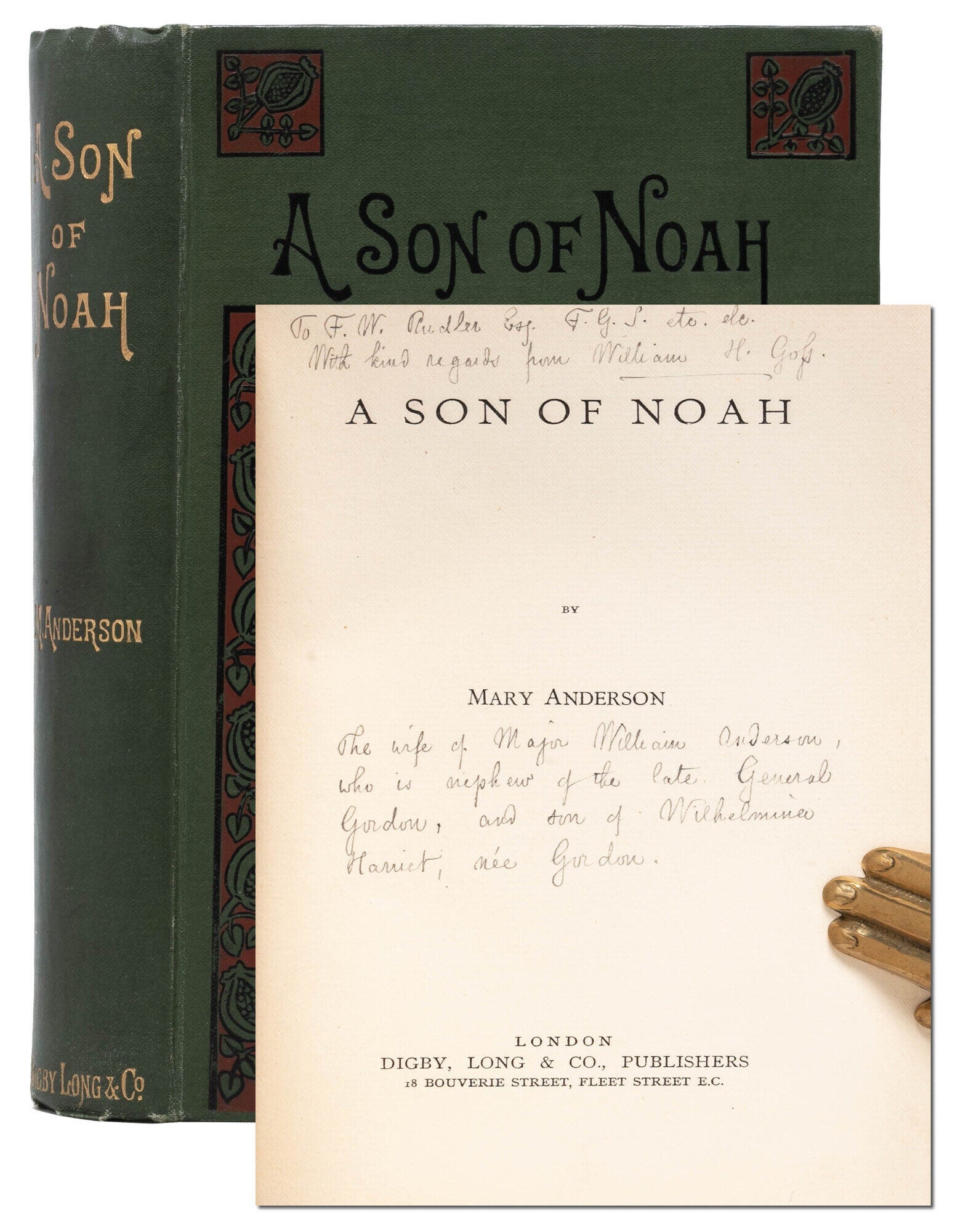
London: Digby, Long & Co., [1893]. First edition. Publisher's dark green cloth stramped in red and black. Octavo. [6], 318 pp. A clear, Near Fine copy of a scarce antediluvian fantasy with prehistoric sci-fi elements. Small blemish to upper board. Unopened. Title-page with contemporary ink gift inscription and notation under Mary Anderson's name: "The wife of Major William Anderson, who is nephew of the late General Gordon, and son of Wilhelmina Harriet, née Gordon."
Mary Anderson's A Son of Noah defies the boundaries of both genres into which critics place it. For John Clute, the work "features many of the conventions of prehistoric sci-fi with the added spice of pterodactyl-worship on the part of a speciously advanced race" (Encyclopedia of Science Fiction). And the Lost Race Checklist calls it "marginally lost race because of sequences about the son of Noah finding an advanced race who worship a pterodactyl" but predominantly Biblical fiction because of its "ante-diluvian setting." More recent work, however, has pointed out that the sci-fi features so frequently touted in criticism only appear within the novel's first eleven pages – and that the subsequent chapters undercut these elements in favor of a feminist re-imagining of the life and experiences of Tirzah, wife of Shem, son of Noah, in the final days leading up to the Flood. In this sense, it is more properly called "Biblical fiction, essentially a moral tale. Many of the characters are familiar from the Bible – Noah and his three sons, Shem, Ham, and Japhet, and the 969 year old Methuselah. The narrative ends with the Flood, and the escape by the Ark of Noah, his family and the animals" (Trussel). The feminist twist comes from focusing on the experience and internal debate experienced by Tirzah as she undergoes what Trussel calls "affairs of the heart": she is resistant to Shem's courtship, loves someone else, but ultimately sees impending doom and "escapes with Shem to the Ark where she becomes his bride" and survives (Trussel). Daring for reasons rarely assigned to it, this unusual genre-bending novel deserves further critical attention.
Anderson (d. 1920) was also the author of Othello's Occupation (1895), a novel told from the perspective of a wealthy Tunisian woman who meets and forms a relationship with Othello preceding the events of the Shakespeare play. We could not find much more information about Anderson, though the contemporary inscription in this copy, if correct, offers additional insight into her background. Anderson's husband William Christian Anderson (1857 - 1917), a Major in the Royal Artillery, served in Egypt in the late 1880s and Gibraltar in the late 1890s. The couple married in 1885, and Anderson was buried in Hampshire in 1920.
Note that several OCLC records list the American actress Mary Anderson (1859 - 1940) as the author of the present work, though this is incorrect. Mix-ups between the two Mary Andersons' identities dates back to the 1893, however, with a contemporary reviewer expressing confusion about whether the novel was written by the actress (The Academy, April 8, 1893). Regardless, Anderson was clearly an innovative and daring author interested in re-analyzing canonical stories from the perspectives of women.
"The Death and Funeral of the Late Mrs. [Wilhemina] Anderson." The Hampshire Independent, Saturday November 25, 1899, p. 6. Near Fine (Item #8202)


