A leaf from each of the Four Folios
London: 1623, 1632, 1664 and 1685.
A leaf from each of the Four Folios
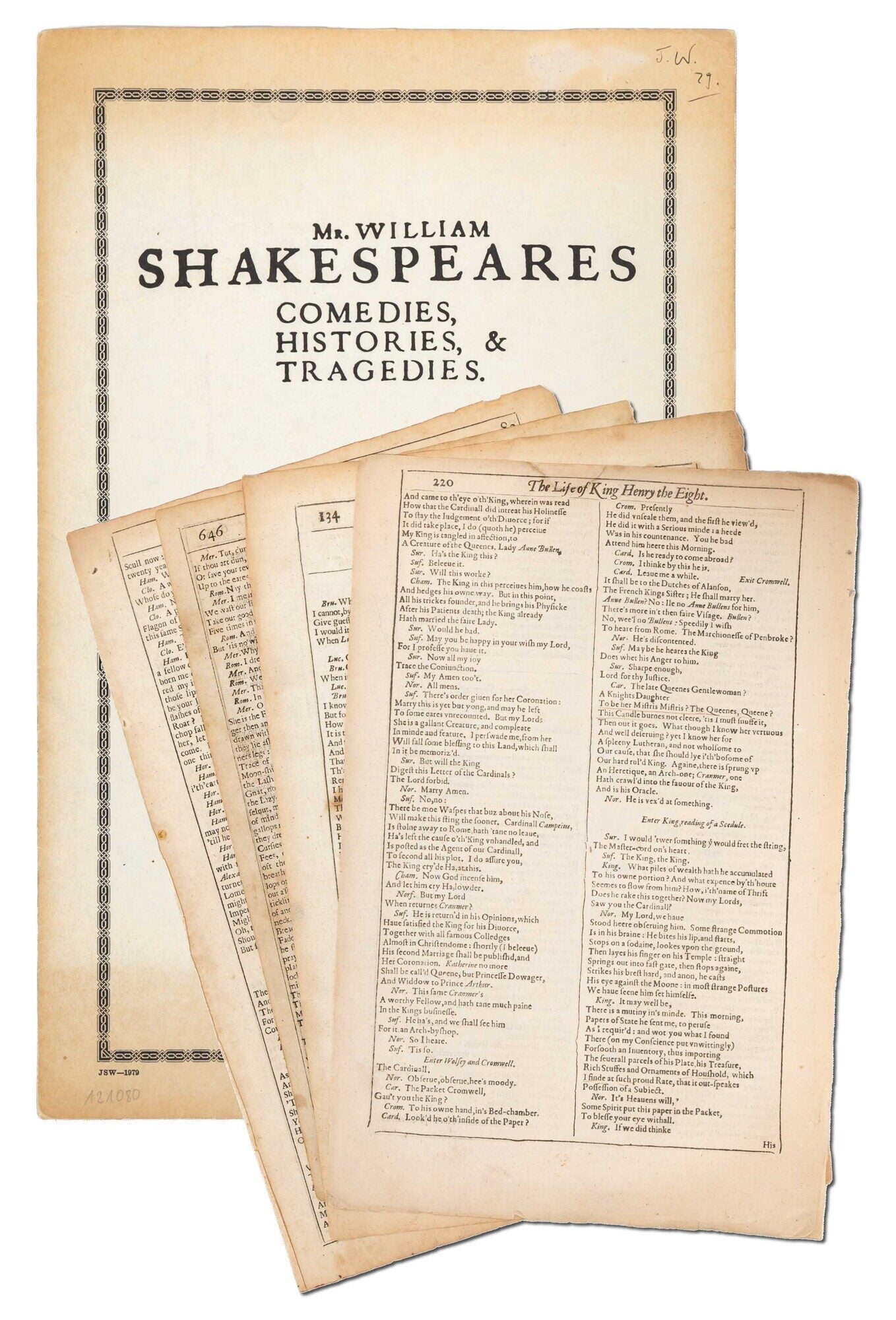
London: 1623, 1632, 1664 and 1685. A leaf from each of the four folios; that is, the first four collected editions of Shakespeare's plays. This set includes a leaf from King Henry the Eighth (First Folio, 1623); Julius Caesar (Second Folio, 1632); Romeo and Juliet (Third Folio, 1664), including the conversation on dreams between Romeo and Mercutio at the masquerade; and Hamlet (Fourt Folio, 1685), including Hamlet's famous "Alas, poor Yorick..." lines in the graveyard. A Near Fine set. Four folio leaves, disbound. Housed in a custom paper folder printed in red and black with pencil annotation "J.W. 79." Small paper repair to margin of First Folio leaf, as well as a bit of faint ink underlining, and some browning to the other three leaves. A very attractive set overall, with the First Folio leaf being a particularly clean example.
The four folios were the only collected editions of Shakespeare’s plays published in the seventeenth century. The First Folio of 1623 is of inestimable importance for English literature, being the sole source for eighteen of Shakespeare’s plays that would have otherwise been lost. The Second Folio of 1632 included an additional encomium by the young John Milton, his first published poem in English, and modernized some of the spelling and punctuation. “The Second Folio was issued when England under Charles I was drifting into civil war. It helped to keep alive the poetry of Shakespeare during the days of the Commonwealth when play-acting was proscribed as a work of the devil” (Willoughby’s introduction). The Third Folio of 1664 added the play Pericles and six spurious Shakespeare plays. It is the rarest of the folios, due no doubt to a large part of the edition being destroyed in the Great Fire of London in 1666. The Fourth Folio completed the great quartet in 1685. It maintained the text of the Third Folio and was in turn used as the basis for the edited texts of the eighteenth century.
The four leaves comprise:
1. First Folio (1623): The Life of King Henry the Eighth, pp. 219-220: End of Act 3, Scene 1 and beginning of Scene 2. Queen Katherine argues with the scheming Cardinal Wolsey and Cardinal Campeius, who attempt to persuade her to put her faith in the King. Then, the Duke of Norfolk, the Duke of Suffolk, Lord Surrey, and Lord Chamberlain enter, and discuss the King's potential divorce from Katherine; Chamberlain reveals that the King has already married Anne Boleyn.
2. Second Folio (1632): The Tragedy of Julius Caesar, pp. 133-134: End of Act 1, Scene 3 and beginning of Act 2, Scene 1. The conspirators Casca, Cicero, Cassius, and Cinna discuss their plan to resist Caesar; in particular, Cinna's scheme to turn Brutus against him. Then, Brutus, in his orchard, contemplates the death of Caesar ("It must be by his death..."), and the conspirators arrive to speak with him.
3. Third Folio (1664): The Tragedy of Romeo and Juliet, pp. 645-646: End of Act 1, Scene 3 and beginning of Scene 4. Juliet, Lady Capulet, and the nurse converse prior to the feast. Then, Romeo, Mercutio, and Benvolio arrive, masked, at the feast; Romeo and Mercutio exchange their famous lines on dreams: "I dreamt a dream tonight." / "And so did I." / "Well, what was yours?" / "That dreamers often lie." / "In bed asleep while they do dream things true."
4. Fourth Folio (1685): The Tragedy of Hamlet, pp. 83-84: End of Act 5, Scene 1 and beginning of Scene 2. Hamlet delivers his famous lines, "Alas, poor Yorick, I knew him, Horatio, a fellow of infinite jest; of most excellent fancy..." to Horatio in the graveyard, until their conversation is interrupted by the entrance of Ophelia's funeral procession. Then, Horatio and Hamlet discuss Hamlet's scheme to avoid his own execution at the expense of Rosencrantz and Guildenstern, and the courtier Osric enters. Near Fine (Item #8186)