
No-No Boy
Rutland, Vermont: Charles E. Tuttle Company, 1957.
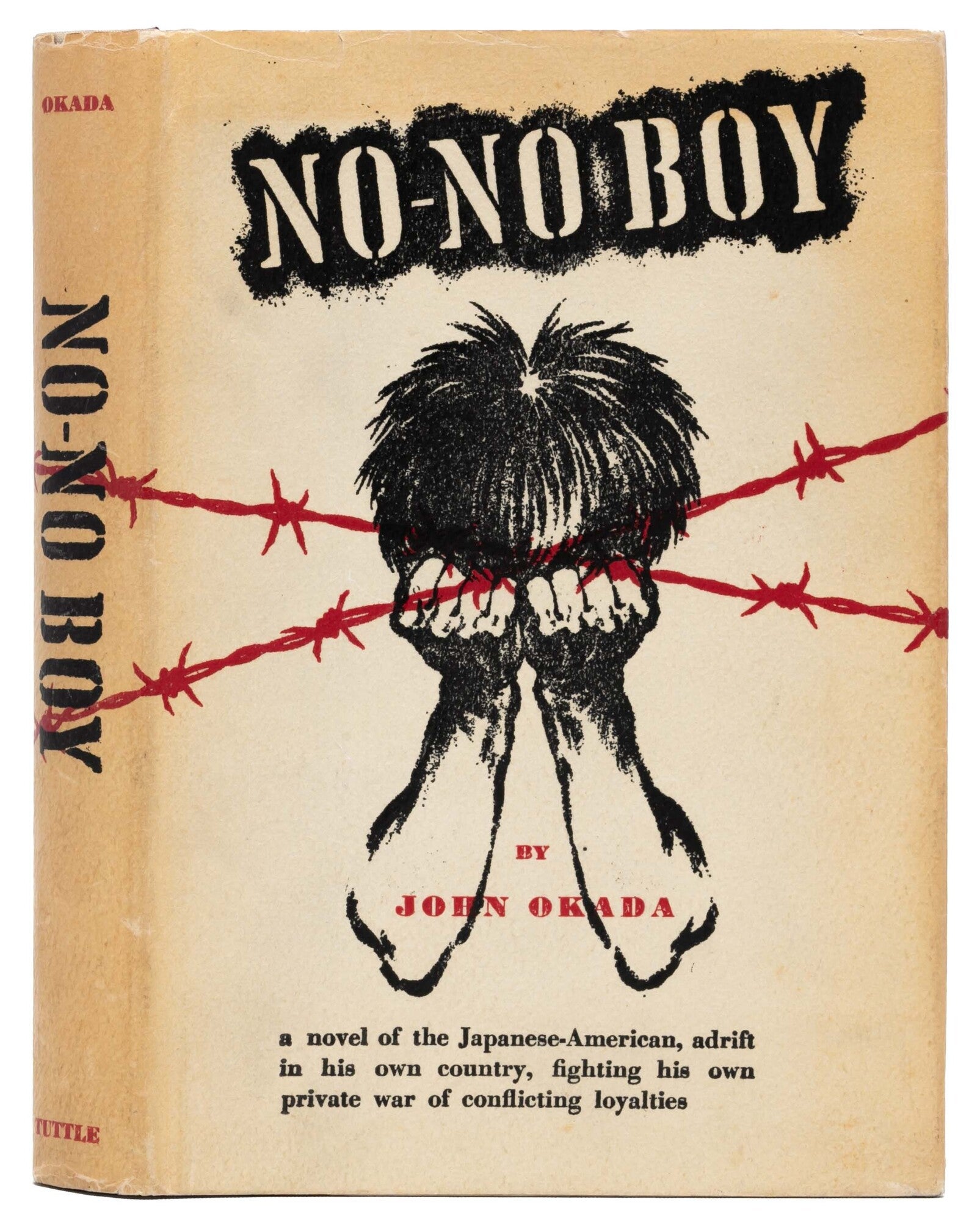
No-No Boy
Rutland, Vermont: Charles E. Tuttle Company, 1957. First edition. A Near Fine copy in like dust jacket. Publisher's quarter gray cloth over boards stamped in red and blind. Sunning to top edge of boards and sight bump to edge of upper board. Clean throughout aside from some toning to endpapers. Dust jacket toned, mostly at spine and back panel. Overall an appealing example.
No-No Boy is a canonical work of Japanese American literature and "the first large-scale fictional work by a Nisei touching the camp experience to appear in print" (The Cambridge Companion to Asian American Literature, p. 46). The novel was inspired by the experiences of John Okada (1923 - 1971) during his imprisonment in a Japanese interment camp, his military service, and his postwar return to civilian life.
In 1942, Okada, along with his family and thousands of other Japanese Americans, was removed from his home, stripped of his property, and imprisoned at the Minidoka War Relocation Center in Idaho. The next year, prisoners at the camp were required to take a "loyalty questionnaire" administered by the United States War Department to determine whether they were eligible for early release. This questionnaire required them to "name references outside camp, list the publications they read, and share other relatively mundane details" before asking two crucial questions: first, were they "willing to serve in the armed forces of the United States on combat duty, whenever ordered" and would they "swear unqualified allegiance to the United States of America...and forswear any form of allegiance or obedience to the Japanese Emperor...?" (Densho). Okada answered "yes" to these questions, resulting in his release from the camp and his immediate recruitment into the Air Force. He went on to study English and library science and write the present novel, which would become a crucial entry in the Japanese American literary canon.
In No-No Boy, Okada's protagonist, Ichiro Yamada, answers "no" to both of the crucial loyalty questions presented to him on the questionnaire. Yamada remains incarcerated and, after the war, is branded a "no-no," a label that carries a powerful "stigma of disloyalty" and isolates him from other Japanese Americans (Densho). More than a novel of wartime, No-No Boy also reflects on the violence of Japanese internment, the impossible situation of Japanese American citizens asked to either risk their lives in war or accept imprisonment and stigma, and the complex question of identity under state surveillance. Near Fine in Near Fine dust jacket. (Item #8152)


