
An Autobiography (Inscribed to an architecture student)
London: Longmans, Green and Company, 1933.
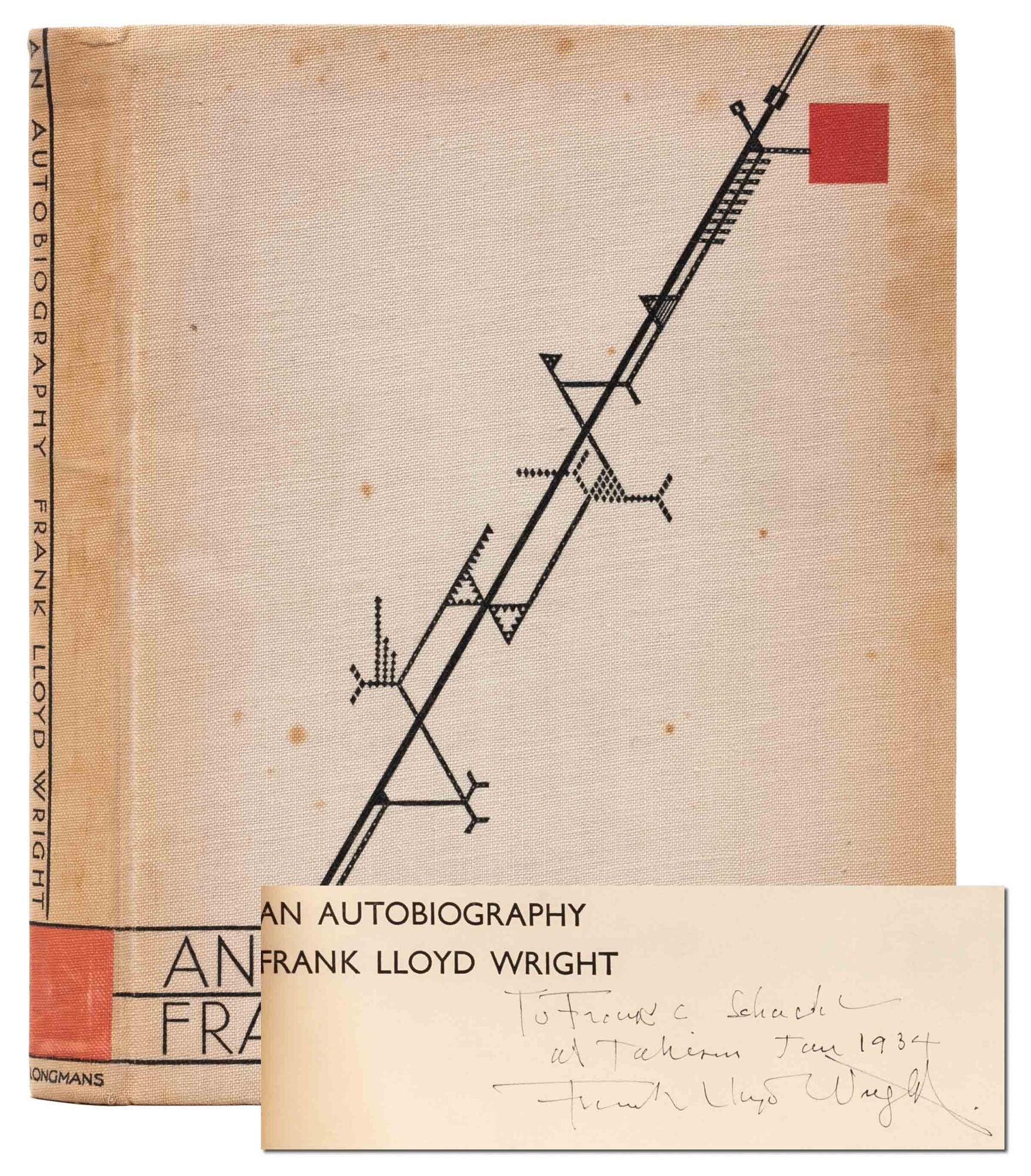
An Autobiography (Inscribed to an architecture student)
London: Longmans, Green and Company, 1933. Second printing. Inscribed by Frank Lloyd Wright to architecture student Frank C. Schacht: "To Frank C. Schacht at Taliesin, Jan 1934, Frank Lloyd Wright." A Very Good copy. Illustrated with twenty-two pages of photographs, plus architectural chapter dividers printed in red and black. Publisher's buff cloth over flexible card wrappers. Lettered in black and stamped in black and red. Toned and foxed at spine and edges, but quite clean internally. With the ownership inscription of Frank C. Schacht, University of Wisconsin (dated January 1934) to upper pastedown.
When Frank Lloyd Wright wrote his Autobiography, he was in his seventies, and had been working as an architect for forty-five years. The first third of the Autobiography chronicles his early life, but the rest is devoted to his work in architecture, including his three Taliesin projects, his work in Japan and in the Midwestern United States, and his desert structures in Arizona. Though Wright had yet to complete some of his most famous projects, including Fallingwater (1939) and the Guggenheim Museum (1959), his Autobiography is a compelling view into his life, philosophy, and already storied career.
We could not locate much information about Frank C. Schacht, though the inscription implies that he was likely a member of Wright's elite Taliesen Fellowship. Beginning in 1932, Wright taught between fifty and sixty architecture students at Taliesin, a home and studio overlooking the Wisconsin River. Though Wright served as a teacher at Taliesin, he considered it to be more of a collaborative working environment than a school: in a 1939 letter, he wrote, "It happens to be our home and where we work, and these young people are my comrade apprentices: no scholars. They come to help, and if they can learn well, we are very happy" (The Collected Writings of Frank Lloyd Wright). The Taliesin project had originally been planned in conjunction with the University of Wisconsin, Wright's alma mater; the plan fell through, but students and graduates of the University of Wisconsin architecture program were well represented among Taliesin fellows. Schacht, whose ownership inscription implies that he studied or was employed at the University of Washington, was likely one of those fellows who also had a connection to the university.
Wright soon established a second campus, Taliesin West, in Arizona, where the school would operate during the winter months. After Wright's death, former Taliesin fellows established the Frank Lloyd Wright School of Architecture, which still operates as the School of Architecture in Scottsdale, Arizona. Very Good (Item #8103)


