
General Kenney Reports (Inscribed to Jack Warner)
New York: Duell, Sloan and Pearce, 1949.
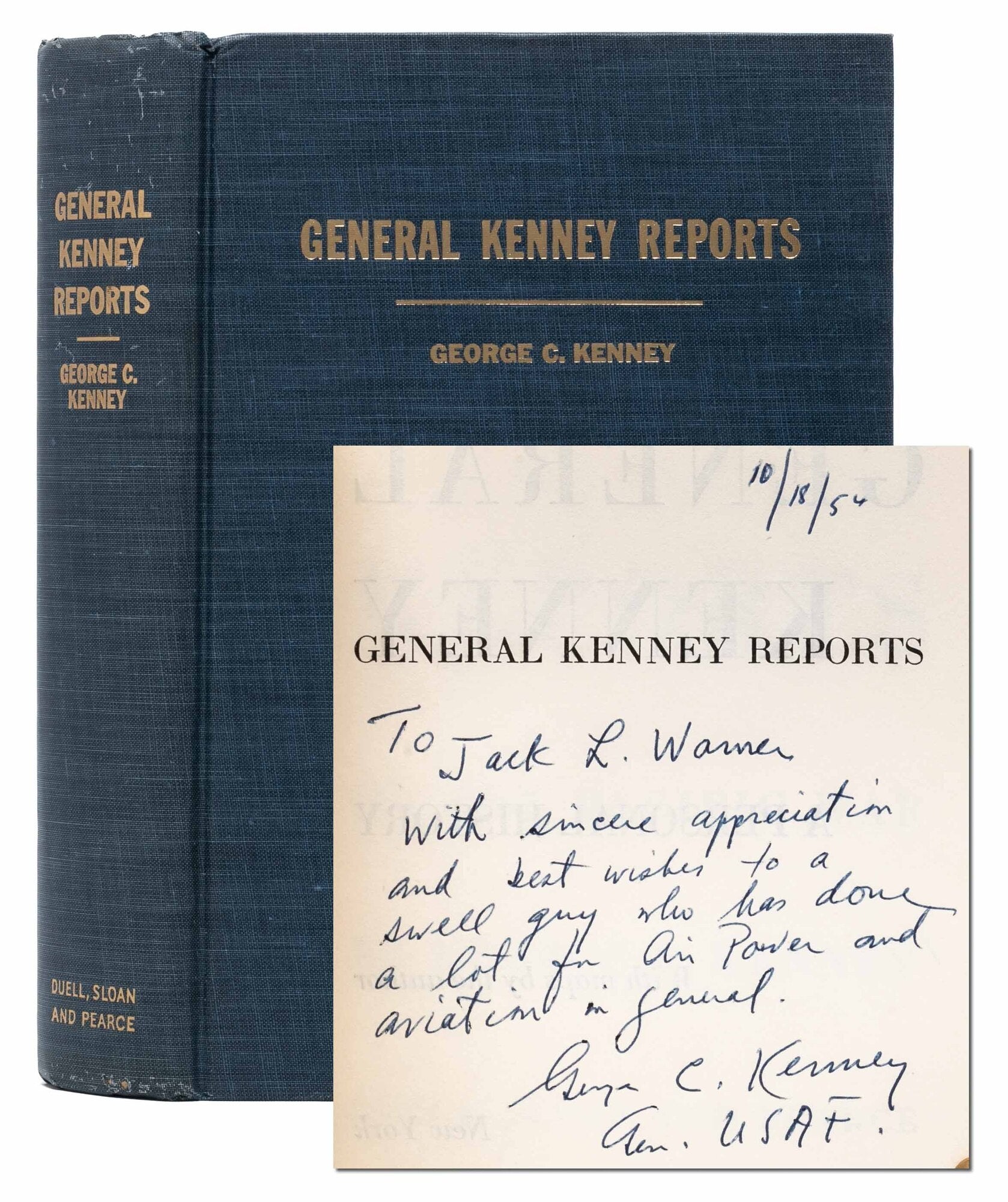
General Kenney Reports (Inscribed to Jack Warner)
New York: Duell, Sloan and Pearce, 1949. First edition. Inscribed by General George C. Kenney to Jack Warner, CEO of Warner Bros. Studios: "To Jack L. Warner, with sincere appreciation and best wishes to a swell guy who has done a lot for Air Power and aviation in general. George C. Kenney. Gen. USAF," dated 10/18/54. The warm inscription commemorates Warner's support of the war effort through the First Motion Picture Unit of the Air Force; Warner was made a Lieutenant Colonel for his contribution. A Near Fine copy. Publisher's blue cloth titled in gilt. Some minor rubbing and toning to spine, otherwise an appealing example with a particularly meaningful inscription.
George C. Kenney (1889 – 1977) was a United States Air Force general who commanded the Allied Air Forces in the Southwest Pacific theater. He almost certainly became acquainted with Jack Warner (1892 – 1978), the co-founder and CEO of Warner Bros. Studios, through the First Motion Picture Unit of the Air Force. The unit depended on Warner Bros. Studios to produce training films and propaganda at a time when the newly-formed Air Force lacked the necessary film experience and equipment to meet their production needs. In honor of his support of the war effort, Jack was made a Lieutenant Colonel in the Air Force.
By the time they were called upon to assist in the war effort, Warner Bros. Studios already had a long history of producing films that were critical of Nazism and of the German government more broadly. Jack and his brothers Sam, Henry, and Albert – sons of Polish immigrants who had fled to the United States in part due to the rampant antisemitic violence in their country – produced films critical of German militarism as early as 1918. Jack remained critical of Germany throghout the rise of Nazism in the early 1930s, even as he and the studio faced backlash for the perspective. In 1939, FBI Director J. Edgar Hoover recommended to Jack that the studio produce Confessions of a Nazi Spy, which became the first explicitly anti-Nazi film to be released by a major American studio. Throughout the war, Warner Bros. Studios continued to produce films with anti-Nazi themes, including, most famously, Casablanca (1943), as well as the controversial Mission to Moscow (1943), a propaganda film produced at the request of President Franklin D. Roosevelt. Near Fine (Item #8082)


