
On the Origin of Species by Means of Natural Selection
London: John Murray, 1859.
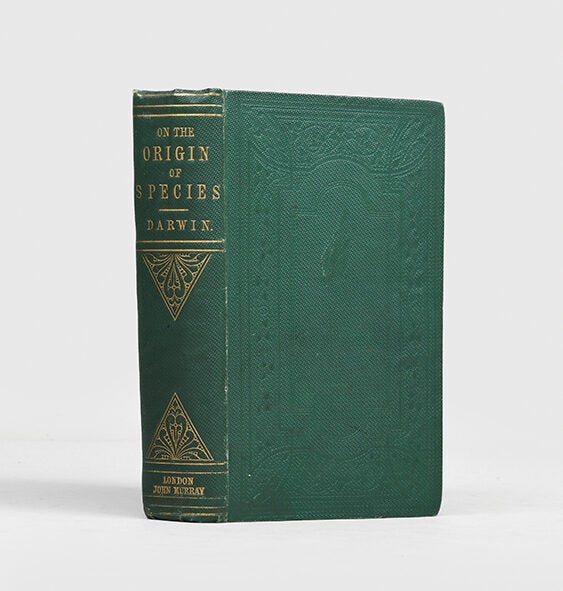
On the Origin of Species by Means of Natural Selection
London: John Murray, 1859. First edition. Frederick Pollock’s copy, his signature dated in the month of publication. A correspondent of Darwin, Pollock’s research on variegated seedlings was later referenced in the Variation (1875). His son, George Frederick Pollock, was a friend of John Murray; it was on his advice that the publisher increased the print run of the first edition from five hundred to over a thousand.
A Very Good copy. Octavo gathered and signed in 12s. Folding diagram lithographed by W. West, 30-page publisher’s catalogue dated June 1859 at rear, lacking final leaf. Original green diagonal-wave-grain cloth (Freeman’s variant b, no priority), spine lettered, ruled, and decorated in gilt, covers ornamentally blocked in blind, light brown coated endpapers, bookseller’s ticket of “Willis & Sotheran. New & Secondhand Booksellers, 136 Strand, London” on front pastedown, binder’s ticket of Edmonds & Remnants on rear pastedown. Housed in custom green slipcase and chemise by James MacDonald Co. of New York. Inner hinges restored. Extremities bumped and lightly rubbed, cloth a little cockled, faint indentation to centre of front cover, evidence of bookplate and smaller ticket removed from front endpapers with resulting discolouration, contents foxed at beginning but majority clean, lower corner of folding plate torn, not affecting text.
Frederick Pollock, 1st Baronet (1783 - 1870), was a lawyer and Tory politician. This copy has his engraved armorial bookplate and his ownership inscription on the title page, “Sir F Pollock, Lord Chief Baron, Nov. 1859." In The Variation of Animals and Plants Under Domestication, Darwin wrote: “Sir F. Pollock has given me more precise information: he sowed seed from a variegated plant of Ballota nigra which was found growing wild, and thirty per cent. of the seedlings were variegated; seed from these latter being sown, sixty per cent. came up variegated” (p. 409).
His son, George Frederick Pollock (1821 - 1915), was a barrister and amateur horologist. According to their relative, the lawyer Edmund Sidney Pollock Haynes, John Murray sought the younger Pollock’s advice “as to publishing 500 copies of Origin of Species. Murray was extremely sceptical as to the soundness of the work, and thought 500 copies as large a number as it was prudent to print. He remarked that the Darwinian theory was as absurd as though one should contemplate a fruitful union between a poker and a rabbit. George Pollock read the book and remarked that the contents were probably beyond the comprehension of any scientific man then living. But he advised publishing 1,000 copies, because Mr. Darwin had so brilliantly surmounted the formidable obstacles which he was honest enough to put in his own path” (Haynes, p. 144-5).
The Origin is “the most influential scientific work of the 19th century” (Horblit) and “certainly the most important biological book ever written” (Freeman). While recognizable theories of evolution had been developing since at least the mid-18th century, the Origin introduces the critical mechanism of natural selection to explain the direction of the process. When combined with Mendelian genetics, natural selection became the foundation of modern evolutionary theory: “Every modern discussion of man’s future, the population explosion, the struggle for existence, the purpose of man and the universe, and man’s place in nature rests on Darwin” (Mayr, pp. vii-xxviii). The print run of the first edition was 1,250 copies.
Dibner 199; Ellis 628; Freeman 373; Heirs of Hippocrates 1724; Garrison-Morton 220; Grolier, English 96; Grolier/Horblit 23b; Grolier, Medicine 70b; Norman 593; Printing and the Mind of Man 344b; Waller 10786. E. S. P. Haynes, The Lawyer: A Conversation Piece (1951); Ernst Mayr, introduction to the Harvard University facsimile edition, 1964.
- Very Good + (Item #7973)


