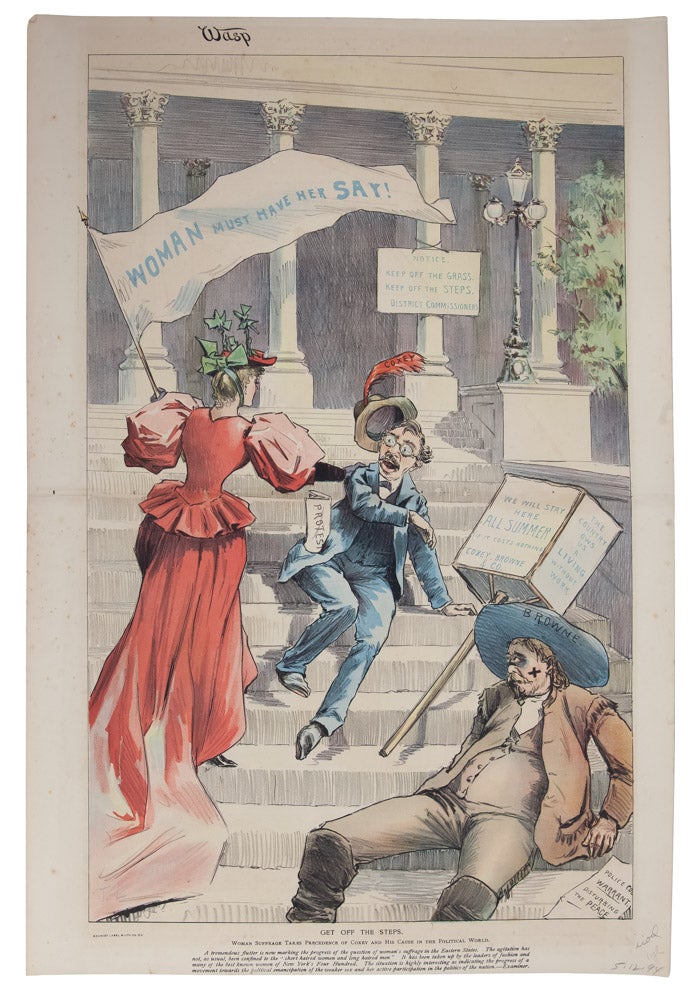
Tracts of Connecticut Woman Suffrage Association. No. 1. Legal Disabilities of Married Women
Hartford: Printed by Case, Lockwood & Brainard, 1871.

Tracts of Connecticut Woman Suffrage Association. No. 1. Legal Disabilities of Married Women
Hartford: Printed by Case, Lockwood & Brainard, 1871. First edition. 115 x 182 mm. 40 pp. Publisher's paper self-wrappers. Some toning and dampstaining, mostly to outer leaves. A bit of minor foxing to first leaf. Creasing to upper corner. A Good+ copy of an important item.
Founded by Frances Ellen Burr and Isabella Beecher Hooker in 1869, the Connecticut Women's Suffrage Association (CWSA) was one of the most prominent local organizations in the women's suffrage movement. The CWSA was staffed by prominent women like Hooker's sister, Harriet Beecher Stowe; Phebe Hanaford; and Olympia Brown, all of whom were engaged in the abolitionist movement as well as the fight for women's rights. Despite the ideological rifts that were already forming in the suffrage movement, early supporters of the CWSA included Susan B. Anthony, Elizabeth Cady Stanton, William Lloyd Garrison, and Julia Ward Howe – the latter of whom was contemporaneously organizing her own extremely influential activist group, the New England Woman’s Suffrage Association (NEWSA). In turn, the CWSA supported the efforts of larger groups like the National Woman's Suffrage Association, along with successfully campaigning for women's voting rights in local elections and for women's labor rights.
These CWSA tracts were the mouthpiece of the organization. The tracts communicated updates on the movement in Connecticut and the ideological stances of the organization, which they articulated in tracts like A Mother's Letters to a Daughter on Woman Suffrage (1870), authored by Hooker; and The Bible and Woman Suffrage (1874), by her husband John. This first tract, Legal Disabilities of Married Women, details the repercussions of coverture – the legal concept that merged a woman's legal status with that of her husband and, as a result, stripped married women of their property rights. Along the path to the 19th Amendment, securing property rights was one of the central goals of the women's rights movement; in 1877, the CWSA also succesfully campaigned for a bill allowing women to retain their property after marriage. Very Good (Item #7550)


![Equal Rights for Women, A Speech by George William Curtis [with] New England Woman Suffrage. Women's Suffrage, American Woman Suffrage Association.](https://whitmorerarebooks.cdn.bibliopolis.com/pictures/3401.jpg?width=768&height=1000&fit=bounds&auto=webp&v=1591634834)
![Equal Rights for Women. A Speech by George William Curtis. Woman's Suffrage Tracts No. 2. [with:]. Suffrage, George William Curtis.](https://whitmorerarebooks.cdn.bibliopolis.com/pictures/7218.jpg?width=768&height=1000&fit=bounds&auto=webp&v=1745427208)