Travels into Several Remote Nations of the World. In four parts. By Lemuel Gulliver, First a Surgeon and then a Captain of Several Ships
London: Printed for Benj. Motte, 1726.
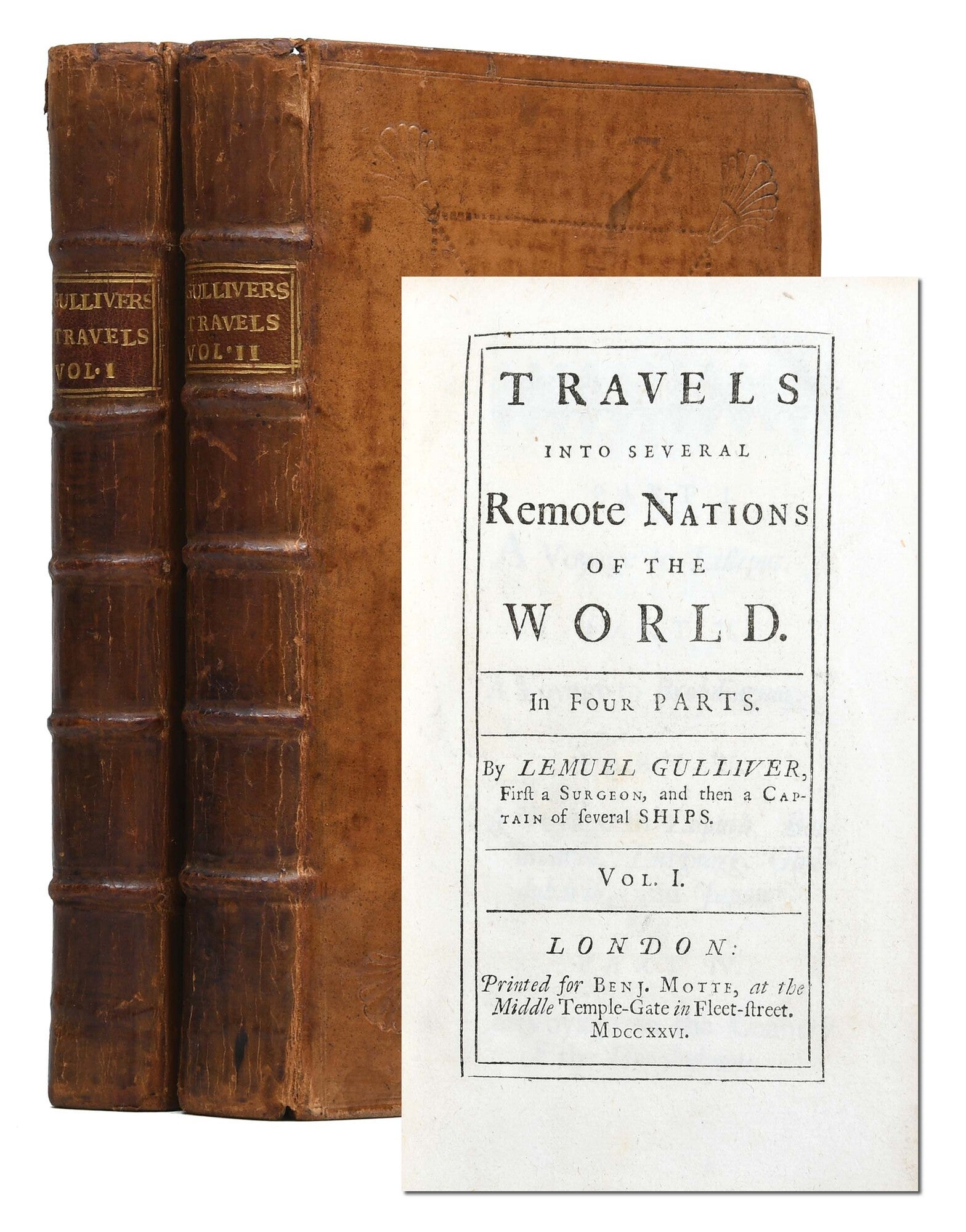
Travels into Several Remote Nations of the World. In four parts. By Lemuel Gulliver, First a Surgeon and then a Captain of Several Ships
London: Printed for Benj. Motte, 1726. First edition. True first edition (Teerink A) of Swift’s masterpiece, published on October 28, 1726. Two superficially similar but distinct octavo editions followed in quick succession: the second (designated AA by Teerink) sometime in the middle of November and the third edition (Teerink B) in December. Two volumes, octavo (195 x 118 mm), in 4 parts, pp. xvi, 148; [vi], 164; [vi], 155, [1]; [viii], 199, [1]. Engraved portrait frontispiece of Gulliver (second state with vertical chain lines as usual), 4 maps and 2 plans, wood-engraved head- and tailpieces and initials. Contemporary trade binding of panelled calf, brown morocco labels, raised bands, red sprinkled edges. Housed in a brown morocco-backed folding case. Monogram book labels ("IKJ"); slip loosely inserted in vol. I with short description of the book by the noted bookseller Lionel Robinson (1897-1983). Spines rubbed, joints just starting at head, a few minor marks internally. A Fine copy in an unrestored contemporary trade binding, scarce and desirable thus.
Swift was safely in Ireland by the time Gulliver’s Travels was published. “The clandestine business of getting into print a pseudonymous and satirically explosive political satire...(known from the start by its more popular title, Gulliver’s Travels) was managed chiefly by Pope, with the assistance of John Gay and Erasmus Lewis. For speed, and to counter the risk of piracy, Motte used five printing houses (those of Edward Say, Henry Woodfall, James Bettenham, William Pearson, and, for the greatest share, that of Jane Ilive). The first edition appeared on 28 October 1726 in two octavo volumes at the price of 8s. 6d., but with unauthorized deletions and insertions by Andrew Tooke (the brother of Benjamin Tooke Jr.), and sold out within a week. Gay wrote: "From the highest to the lowest it is universally read, from the Cabinet-council to the Nursery'...Swift received from Motte £200 and possibly more from the sales of the book, largely due to Pope’s effort at instilling into his friend the principles of ‘prudent management'...Gulliver’s Travels is the book by which Swift is chiefly remembered” (ODNB).
Printing and the Mind of Man 185; Rothschild 2104; Teerink 289 (“A edition”). Jonathan Swift, The Correspondence, David Woolley, ed., 1999. Fine (Item #7333)