
A Voice from the South. By a Black Woman of the South
Xenia, Ohio: Aldine Printing House, 1892.
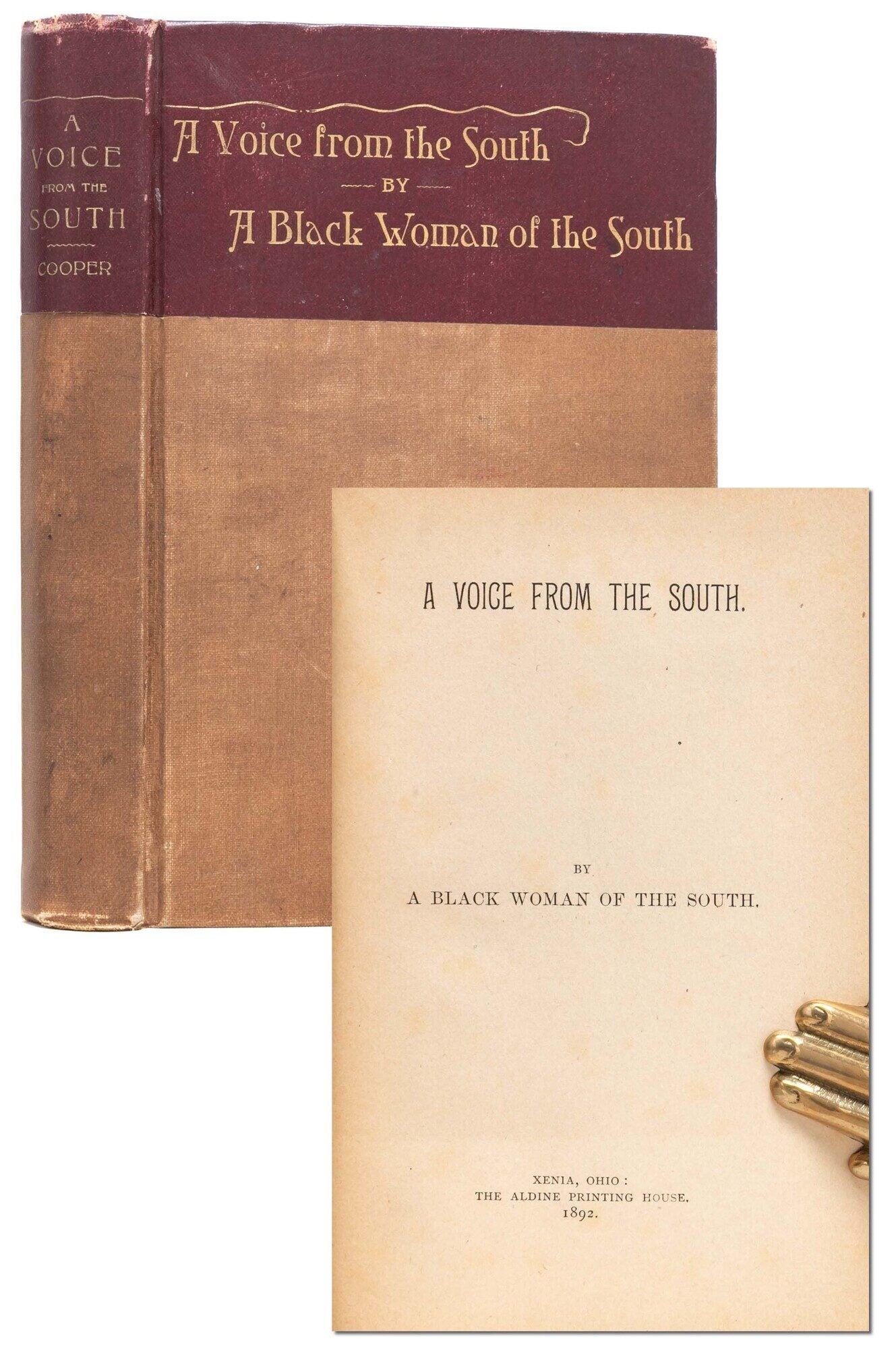
A Voice from the South. By a Black Woman of the South
Xenia, Ohio: Aldine Printing House, 1892. First edition. Publisher's brown and red cloth boards titled in gilt. [6], iii, [2], 9-304 pp. Despite odd pagination, work is complete, with the frontispiece. Dampstain to lower board. Top edge gilt. Fore-edge of closed text block with red pencil scribble. Pencil gift inscription, dated 1896, to upper pastedown. Early ink ownership inscription to preliminary blank. Occasional pencil marginalia. A Very Good copy of a scarce early Black feminist work.
Anna Julia Cooper, née Haywood (1858 – 1964) was an educator and translator who broke ground with her Black feminist scholarship. Published in the same year as Ida B. Wells' Southern Horrors and Ellen Watkins Harper's Iola Leroy, A Voice from the South compiles eight of Cooper's essays, including "Womanhood a Vital Element in the Regeneration and Progress of a Race," "The Higher Education of Woman," and "Has America a Race Problem; if so, How Can it be Solved?" The essays address the struggle of Black women to build identity and success in a hostile, racist environment, but also prophesize a more equitable future liberated from misogyny, racism, and greed. As Vivian M. May writes in her Critical Introduction to Cooper's work, "In A Voice, Cooper theorizes from her own experiences as a Black woman to highlight how race and gender politics are interlocking, to speak out against myriad forms of violence and domination, and to insist upon the right of all marginalized people to self-determination and self-definition. Highlighing how seemingly different experiences and identities are connected, Cooper insists upon an inclusive model of liberation and human rights...Cooper raises her voice to issue a call to action and to emphasize the powerful knowledge and radical imagination that exist in the margins" (p. 2). A Voice, which was widely acclaimed upon its publication both in the United States and abroad, is still appreciated by modern scholars for Cooper's analysis of the interlocking effects of misogyny and racism – in many ways, her work presages the intersectional feminist work of activists like Kimberlé Crenshaw and Angela Davis.
Born into slavery in North Carolina, Cooper began teaching at a local school when she was just nine years old. She eventually attended Oberlin College, graduating with a master's degree in mathematics, and earned her doctorate from the Sorbonne, where she studied the connection between the French Revolution, Haiti, and global slavery (culminating in her 1925 doctoral thesis L'Attitude de la France à l'égard de l'esclavage pendant la Révolution). Over the course of her lifelong career as an educator, she taught at Wilberforce University; the Dunbar High School (also known as the M Street School), a prestigious Black high school in Washington, D.C.; and Frelinghuysen University, where she also served as President. Cooper was also a member of the Phyllis Wheatley YWCA Board of Directors, an NAACP member, and delegate at the first London Pan-African Congress in 1900, where she was one of just two Black women invited to present a paper. In advance of the Congress, Cooper had also been among a small number of elected officers of the Pan-African Congress Executive Committee, working to communicate with heads of state around the world (including Queen Victoria, whom they urged to end the Boer War). Along with A Voice from the South, Cooper's other works include The Life and Writings of the Grimké Family (1951), which she edited; and many scholarly publications. Very Good (Item #7215)


