
Leviathan (Large-Paper copy)
London: Printed by Thomas Warren and Richard Cotes for Andrew Crooke, 1651.
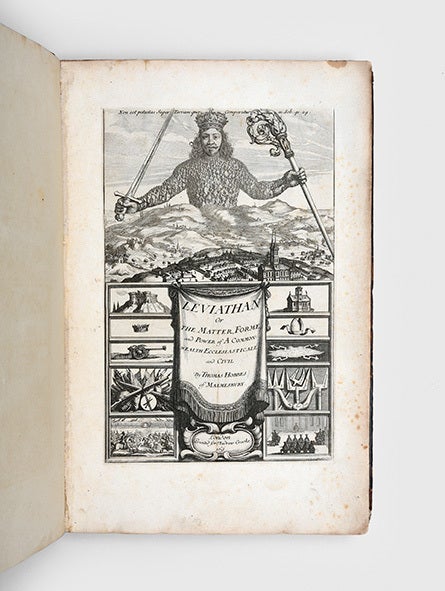
Leviathan (Large-Paper copy)
London: Printed by Thomas Warren and Richard Cotes for Andrew Crooke, 1651. First edition. A rare large paper copy, pages measuring 321 x 208 mm (our last standard copy measured: 276 x 178 mm). Contemporary polished calf, ruled in gilt. Rebacked (mid-20th century) with a new spine label and new end papers. Ornament of winged head on the title page (marking the first issue), folding letterpress table retaining the directions to the binder, but with a small piece excised. Collating: [vi], 356; complete with the additional engraved title and the letterpress table between pgs 40-41. Minor soiling and some toning throughout, but gernally a clean, unwashed copy. Prior cataloguer has written in ink: "collated perfect" on the final page. A Very Good copy. The last large paper copy on the market made $150,000 at the Pirie sale (Sothebys 2015).
As with many other English works in the period, the printer ran off a small number of copies on larger and better-quality paper, for distribution to patrons and friends or for sale at a premium price. Large-paper sheets were either printed at the beginning of the run for that forme, or, more commonly, at the end to include all corrections. The large-paper Leviathan copies are the latter. “This does not mean that the large-paper copies are perfectly reliable. They contain not only those typographical errors that were never corrected but also two kinds of error that arose during the printing process: some letters dropped out of the forme, and some -in-press corrections (typically, replacing letters that had dropped out) were botched, creating new errors. Nevertheless, the general superiority of the large-paper copies is clear...
The large-paper copies in general are certainly more impressive, physically, than the rest of the edition. Whereas the normal copies are typically 27.5 x 18 cm, the large-paper copies range from 32 x 21 to 33.5 x 22 cm. The paper is indeed of finer quality; it has a watermark of a shield containing two lions, and was produced by Richard Guesdon (or Guédon) in Normandy... In several cases, the original owners of the large-paper copies were people connected personally with Hobbes; these copies were evidently used as gifts by the author” (Malcolm, p. 222-6). Malcolm identifies copies presented to John Cosin, John Selden, and Gilbert Ward, and copies possibly presented to Ralph Bathurst, Charles du Bosc, and the Earl of Ailesbury. He notes there are several other large-paper copies whose original owners cannot be identified. He records that the total number of large-paper copies printed is unknown, but cites cases of similar books having between 25 and 60 large-paper copies. It is possible that Hobbes received the large-paper copies as payment for the work.
Armorial bookplate on the verso of the engraved title page Dr. Philip Bisse, Lord Bishop of St. Davids (1710-1713).
We do well to remember that as a survivor of England's bloody Civil War and numerous political uprisings throughout the Tudor period, it is unsurprising that he would theorize life in the state of nature as "solitary, poor, nasty, brutish, and short." “The State, it seemed to Hobbes, might be regarded as a great artificial monster made up of individual men, with an existence which could be traced from its generation through human reason under pressure of human needs to its destruction through civil strife proceeding from human passions. The individual (except to save his own life) should always submit to the State, because any government is better than the anarchy of the natural state... Though Hobbes’s ideas have never appealed to proponents of the individual rights of men, or at the other end of the scale to the modern totalitarians with their mystical visions of Volk, the fundamental nature of his speculation has stimulated philosophers from Spinoza to the school of Bentham, who reinstated him in his position as the most original political philosopher of his time” (Printing and the Mind of Man).
ESTC R17253. PMM 138. Pforzheimer 491. (Item #6897)


