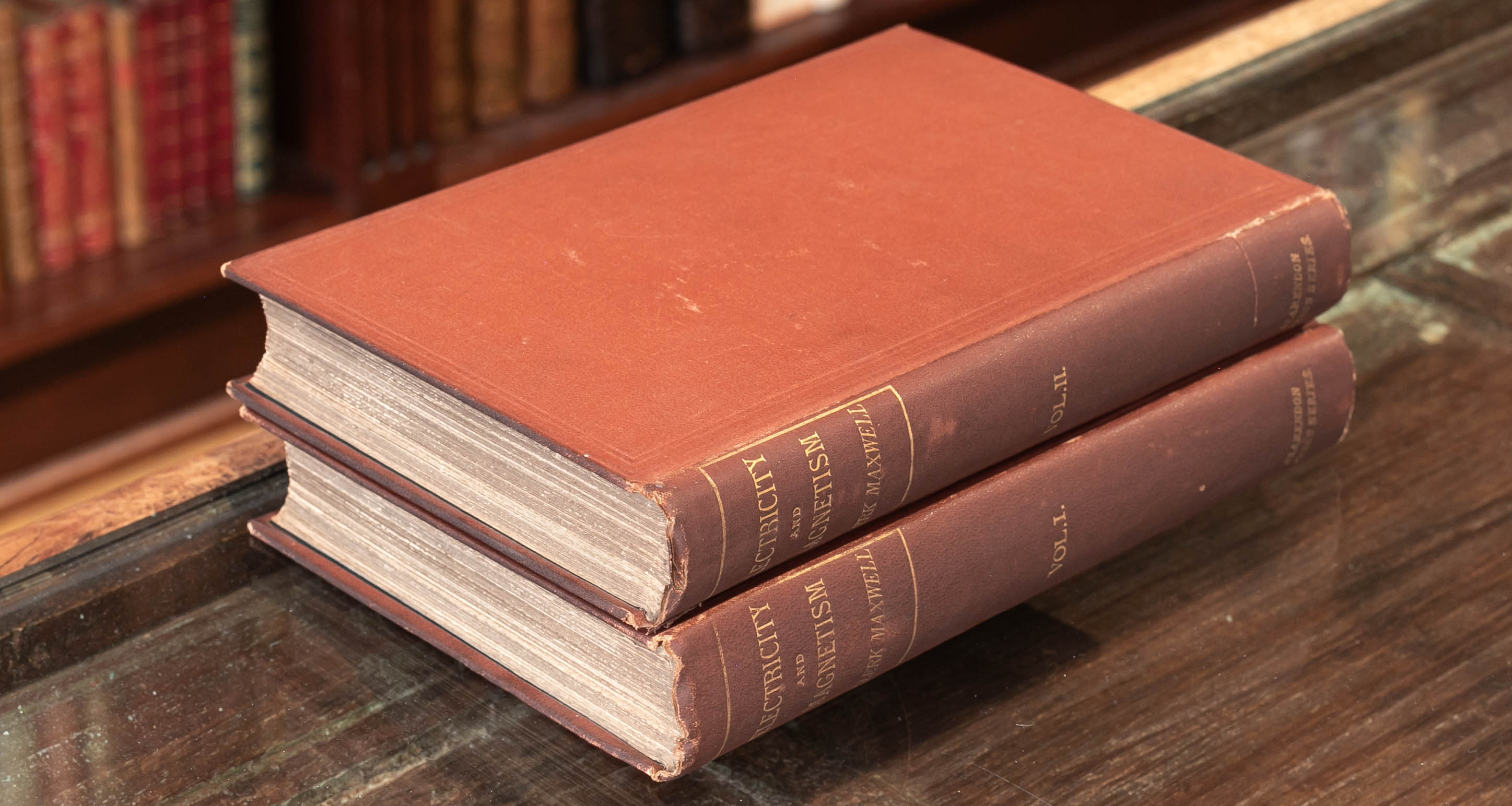
A Treatise on Electricity and Magnetism (in 2 vols.)
Oxford: at the Clarendon Press, 1873.
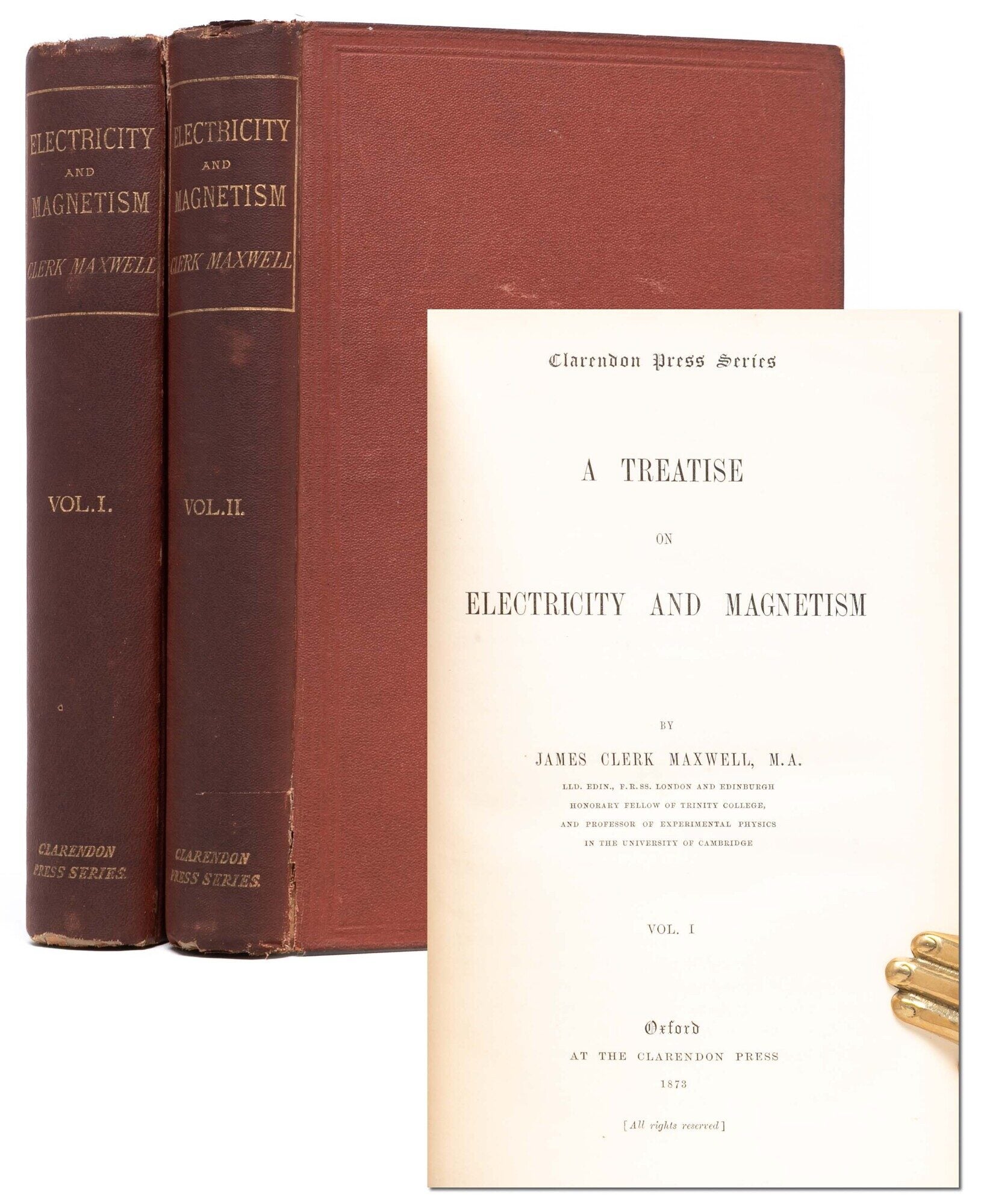
A Treatise on Electricity and Magnetism (in 2 vols.)
Oxford: at the Clarendon Press, 1873. First edition. First edition, first issue, a well-preserved copy of a work that laid the foundations for Einsteinian relativity. Maxwell “may well be judged the greatest theoretical physicist of the 19th century... Einstein’s work on relativity was founded directly upon Maxwell’s electromagnetic theory; it was this that led him to equate Faraday with Galileo and Maxwell with Newton” (PMM). Two vols, octavo. Original reddish brown cloth, dark green endpapers, mostly unopened. This appears to be a variant publisher’s binding: the lettering and blind panelling matches that of the more commonly seen plum-coloured cloth, but it is without the blind-stamped arms of the Clarendon Press on the covers. Housed in a custom orange cloth flat-back box. With 21 engraved plates, formulae and diagrams in the text, errata slip tipped in before p. [1] of vol. I. Late 19th-century bookplate of one Franklin B. Lord, possibly the American lawyer (1850-1908) who donated to scientific causes, to front pastedown of vol. I. Light wear and bumping, spines darkened but otherwise cloth very bright and clean, a little splitting to joints of vol. II, minor browning and foxing to contents: a very good copy.
The first issue includes the phrase “just published” (describing the Treatise) in the 16-page publisher’s advertisements and errata slip tipped into Volume I. The second issue removes the former phrase and contains full-page errata leaves in both volumes (signed X1) in place of the slip. This copy includes the errata slip in Volume I but is bound without the advertisements at the rear of Volume II. Horblit notes that some copies were issued thus.
The Treatise is Maxwell’s most comprehensive exploration of electromagnetic theory. Unlike other foundational works, the Treatise is a self-confessed work in progress. “It is a studio rather than a finished work of art. The studio, being Maxwell’s, is tidily arranged; and once one has grasped what is going on, it is wonderfully instructive to watch the artist at work” (DSB IX, p. 204). The work offers a mathematical expression of electromagnetic theory, bringing together light and electricity as part of the same physical phenomenon.
Maxwell “began the investigation of moving frames of reference, which in Einstein’s hands were to revolutionize physics; gave proofs of the existence of electromagnetic waves that paved the way for Hertz’s discovery of radio waves; worked out connections between the electrical and optical qualities of bodies that would lead to solid-state physics; and applied Tait’s quaternion formulae to the field equations, out of which Heaviside and Gibbs would develop vector analysis” (Norman).
Grolier/Horblit 72; Norman 1466 (second issue); PMM, 355. Near Fine (Item #6637)