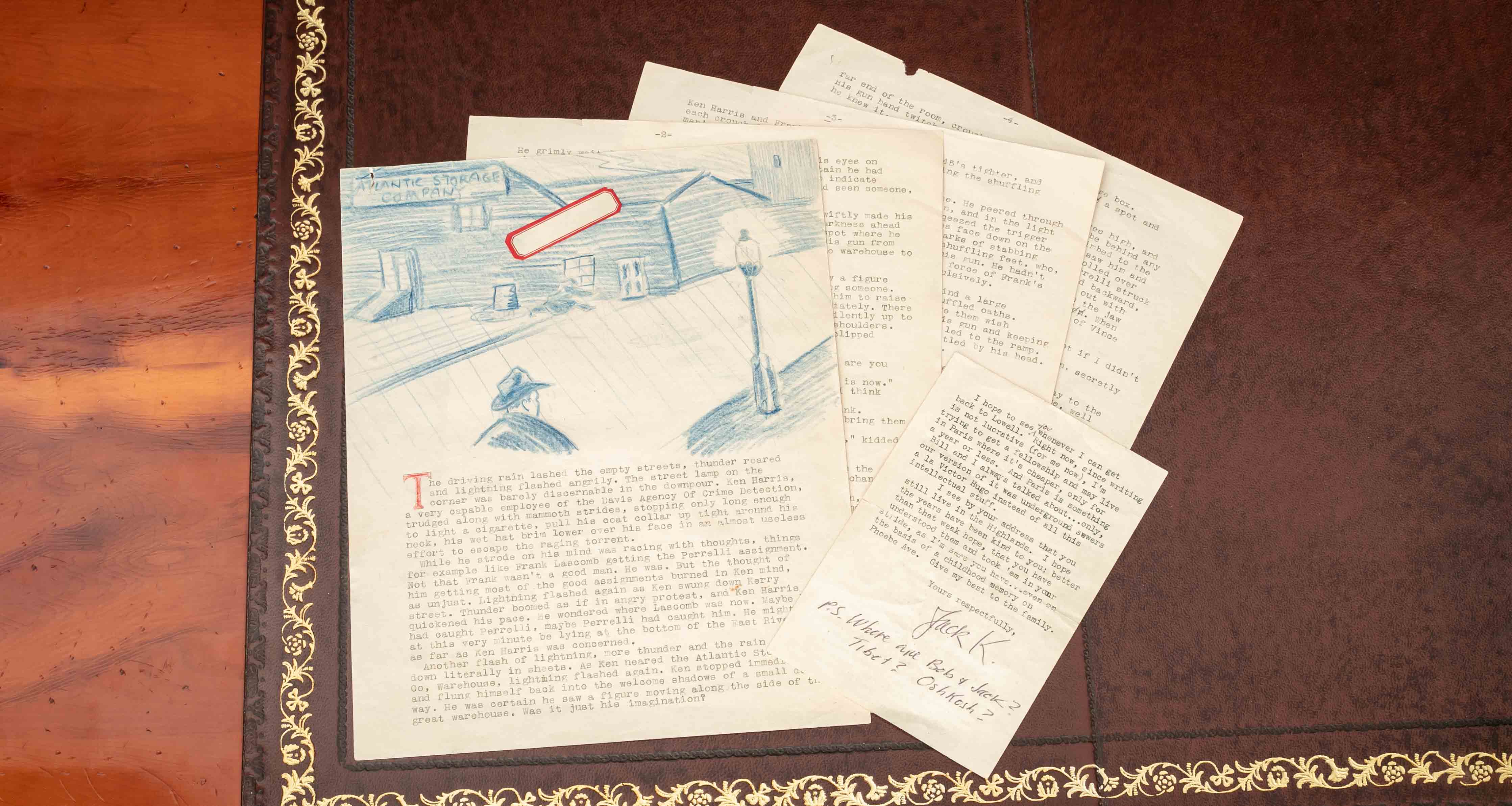
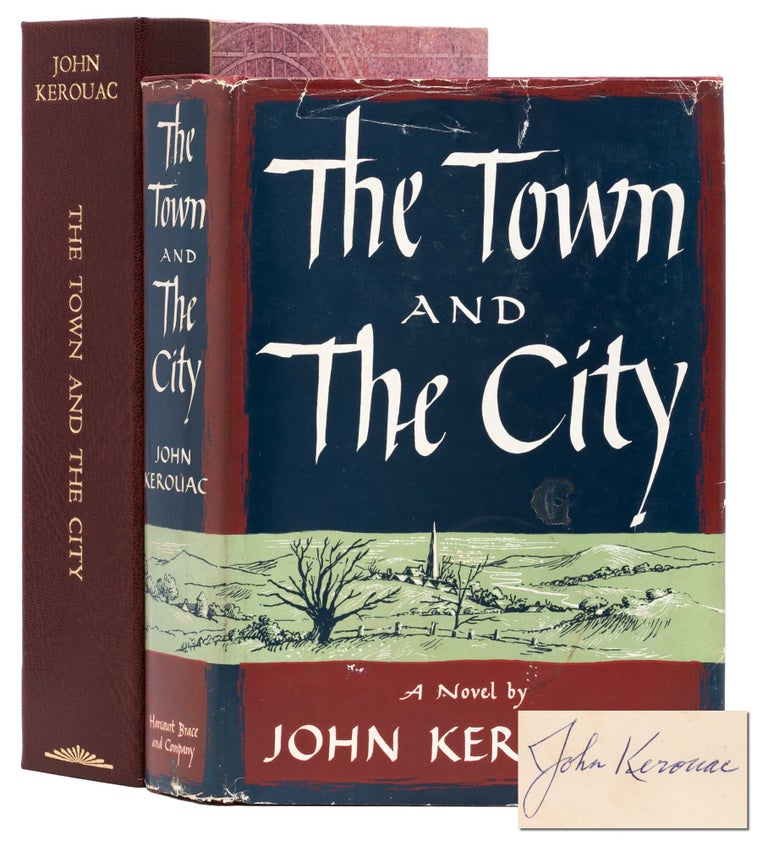
Original Illustrated Typescript Story, with Typed Letter, Signed ("Jack K."), to Mrs. A. B. Chandler ("Dear Mrs. Chandler"), dated April 12, 1950.
Lowell, MA: c. 1938.
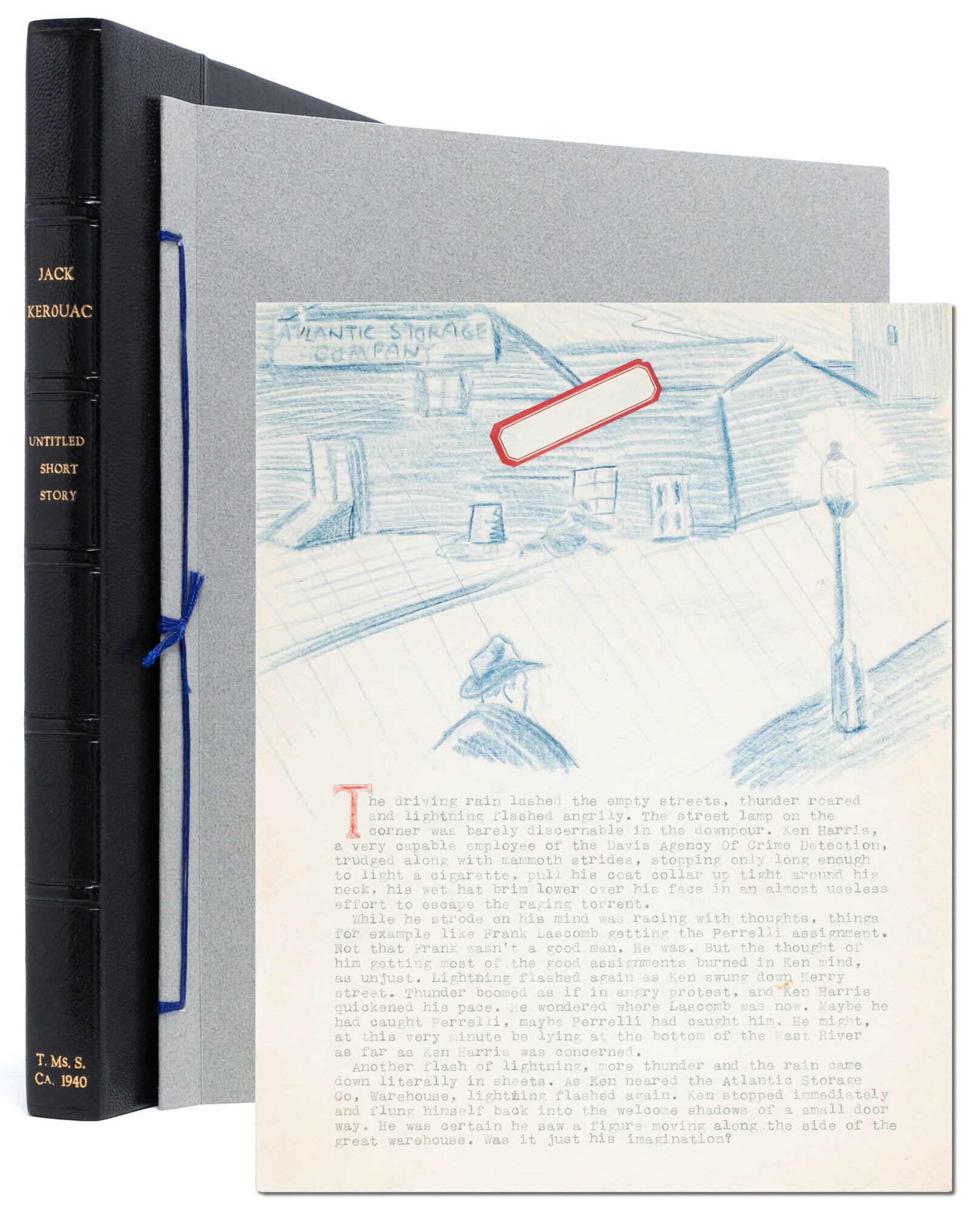
Original Illustrated Typescript Story, with Typed Letter, Signed ("Jack K."), to Mrs. A. B. Chandler ("Dear Mrs. Chandler"), dated April 12, 1950.
Lowell, MA: c. 1938. 4 pp. typescript; 1 pg. letter with franked envelope. Typescript 4to.; letter 8vo. Four leaves typescript, rectos only; original drawing in blue pencil at top of first leaf, with small sticker; several typed emendations throughout; lightly tanned at edges; a few minor chips to last leaf; letter typed recto and verso; one autograph emendation; signed in black ink, with autograph postscript; with typed, franked envelope; several autograph annotations on rear; lightly stained. Housed in a custom quarter-morocco slipcase with chemise.
A previously unknown story by a juvenile Jack Kerouac, part of a series of tales he wrote in Lowell, MA, alongside his childhood friend, William "Billy" Chandler, who Kerouac later featured as a character (Tommy Campbell) in his first novel, The Town and the City. It was almost certainly that book's February 1950 publication which prompted Chandler's mother to write to Kerouac, and his charming response, included with the typescript, registers his pleasant surprise that any of his early work still existed.
In the note, Kerouac states that "Your letter was most kind, and most welcome, and is most treasured now," adding that his mother and sister "were also interested in reading it." He continues, "That you have some of Billy's boyhood writings, and some of mine, moved me most; and I sure would like to see them sometime, perhaps the next time I visit Lowell, if that is acceptable to you and I'm sure it is." After commenting on Mrs. Chandler's other children, Kerouac writes, "I have other, and better stories to write about Billy than the brief episode in this last book, and I'm sure you'll enjoy them when they're written someday...concerning our newspaper, our cartoons, our marble racehorses, pole-vaulting, boxing, sand-traps on the sandbank and then the time we haunted the Boston waterfront." The recollections are all the more poignant as Chandler died during World War II, a fact Kerouac alludes to with, "...Paris is something Bill and I always talked about... only, our version of it was underground sewers a la Victor Hugo instead of all this intellectual stuff."
This typescript was one of the youthful writing samples Mrs. Chandler had referred to. The four page story follows the exploits of Ken Harris, "a very capable employee of the Davis Agency of Crime Detection," as he pursues the gangster Vince Perrelli at a waterfront warehouse on a stormy autumn night. Harris "trudged along with mammoth strides, stopping only long enough to light a cigarette, pull his coat collar up tight around his neck, his wet hat brim lower over his face in an almost useless effort to escape the raging torrent," as "thunder roared and lightning flashed angrily."
While at times utilizing the melodramatic language of the era's popular hard-boiled crime narratives — "Ken's heart began to race wildly"; "Shoot first and find out who you shot afterward"; "Thunder roared, and with it the barks of stabbing automatics"; "sent a hot slug sizzling by Ken Harris' head": "fury of a cyclone" — the plot is nonetheless tightly composed, with well-wrought action sequences and dialogue, and Kerouac also incorporated some rather sophisticated vocabulary for a teenager, such as "Stygian darkness." An extra embellishment is Kerouac's original illustration at the top of the first page, executed in blue pencil, depicting Ken Harris' approach to the Atlantic Storage Company warehouse, illuminated only by a single streetlight, perhaps one of the "cartoons" he mentions in the letter to Mrs. Chandler.
The story ends with a cliffhanger, punctuated only by a terminal ellipsis, so Kerouac clearly intended the adventure to continue. As the University of Massachusetts at Lowell has in its Kerouac collection a copy of a radio script written by him, listed under the name of Billy Chandler, those types of serials were indeed part of the many projects the two boys worked on together.
While the location of the action is not named, it is almost certainly Lowell, which, as a former mill town, had numerous warehouses along the Merrimack and Concord Rivers, as well as on the banks of its commercial canal system. Kerouac specifically mentions Kerry Street, a residential block that may reference someone he knew there, and the "East River" is likely a stand-in for the city's Eastern Canal, where today the Jack Kerouac Commemorative and Park are situated. (Item #6538)