
The French Revolution. A History (Family presentation copy)
London: James Fraser, 1837.
The French Revolution. A History (Family presentation copy)
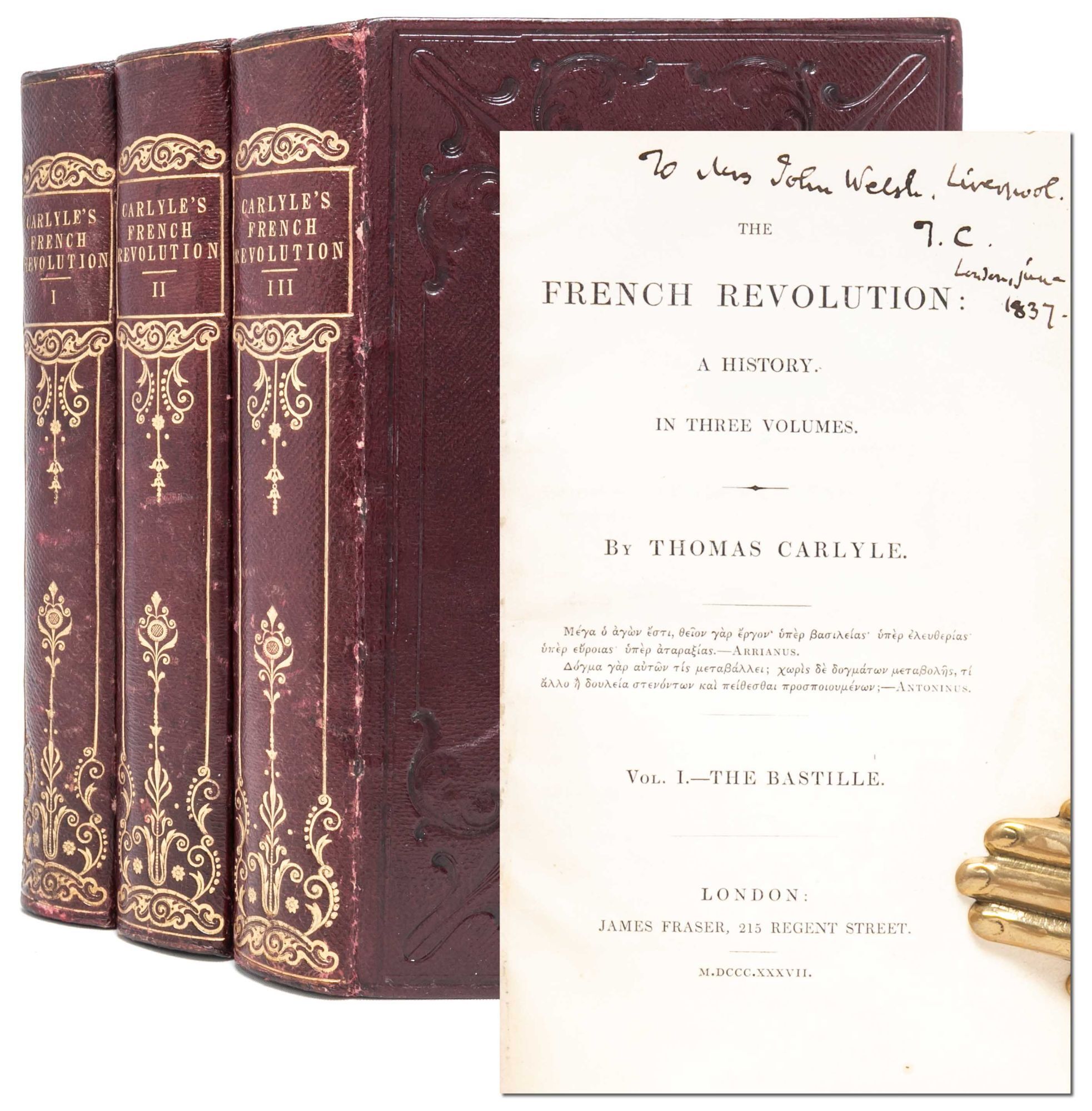
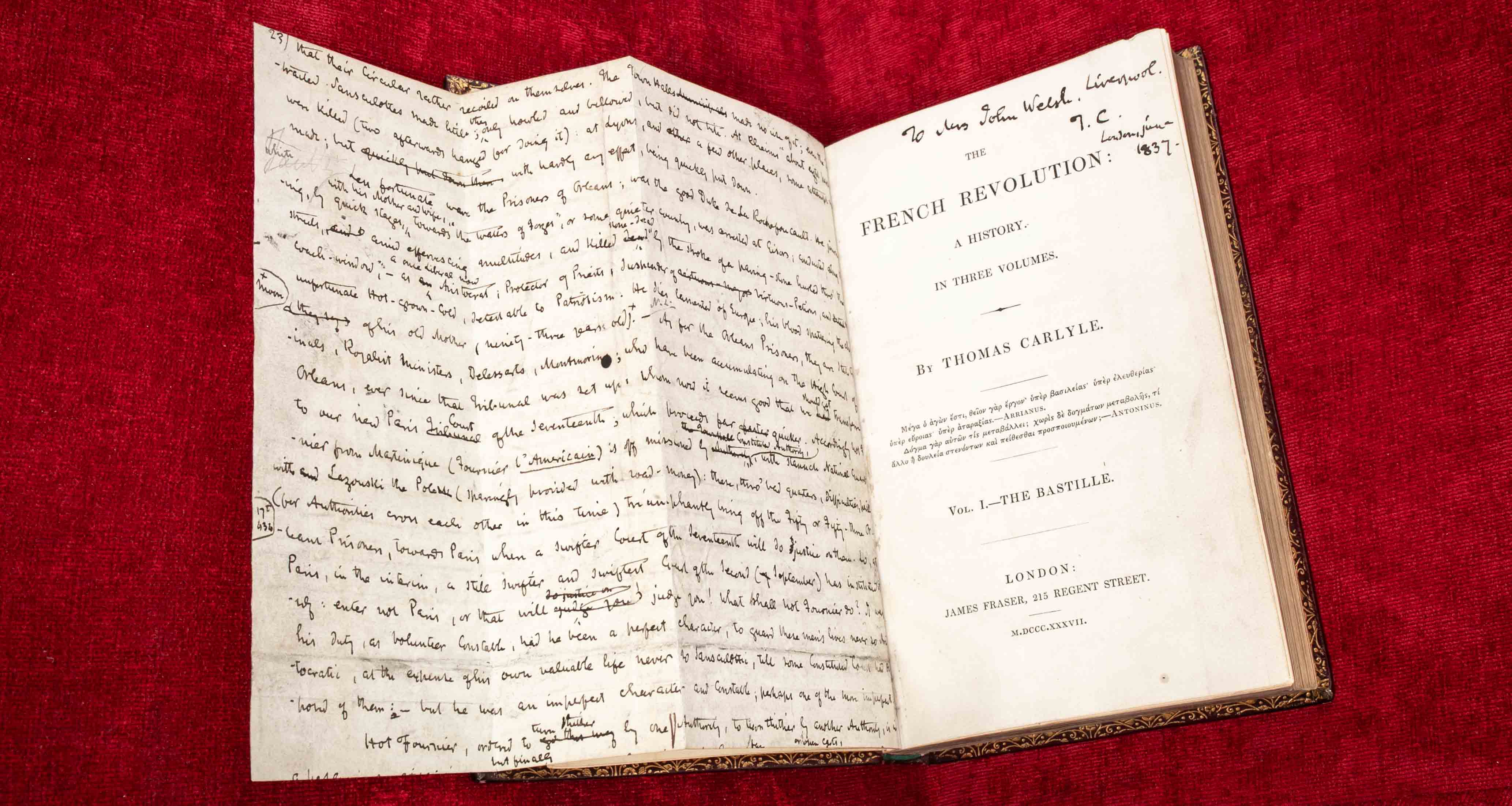
London: James Fraser, 1837. First edition. Bound for presentation and inscribed by the author to his mother-in-law on the title page of the first volume: “To Mrs. John Welsh. Liverpool. T.C. London, June 1837.” A leaf of the original manuscript, written across two sides, is bound in facing the title. Three volumes, octavo (182 x 115 mm). All volumes bound without half-titles, volume two bound without leaf of publisher’s advertisements at rear. Contemporary full purple morocco, spines lettered and decorated in gilt, covers with decorative border and central ornament in blind, turn-ins in gilt, light yellow coated endpapers, edges gilt. Housed in custom red morocco book-form case. Margins of manuscript leaf slightly trimmed. Volume three signature P4 bound after P8. Aside from light rubbing to extremities and very minor sunning to spines, bindings bright and fresh. Scattered light foxing. A highly attractive, Near Fine copy. Presentation copies of Carlyle’s magnum opus are extremely scarce.
The History was published in May 1837. Grace Welsh (1782 - 1842), the mother of Jane Welsh Carlyle (1801 - 1866), is recorded as visiting the couple in London at the end of May, whereupon Thomas removed himself to rural Scotland. Grace had not approved of her daughter’s choice to marry Carlyle in October 1826. In Jane’s own words, writing to him without her mother’s knowledge made her “as nervous as if I were committing a murder” (ODNB). Grace leased the pair a modest home in Edinburgh shortly after their marriage, but relations between mother and daughter remained fraught throughout their lives. While writing the History, Carlyle observed of one maternal visit that “Jane and her mother cannot live together” (quoted in Ireland, p. 151).
The manuscript leaf preserves the text for pp. 58-62 of volume three, discussing the aftermath of the September Massacres of 1792. It runs to forty-five lines and contains several corrections and crossed-through sections, including some two and a half lines not printed on p. 59. The final manuscript of the History was largely destroyed after publication, only fragments remaining. This copy remained in the Welsh family until 1938, when it was sold at Sotheby’s after the death of Mary Chrystal, the granddaughter of Jane Welsh’s uncle.
Carlyle’s History remains one of the most authoritative accounts of the early Revolution. The work established his reputation as an intellectual and influenced many of his contemporaries – including Dickens, whose Tale of Two Cities drew heavily from it. “The book at once captured the English-speaking world, and has, outside France, moulded popular conceptions of the French Revolution down to the present day” (PMM).
Dyer p. 85. Printing and the Mind of Man, 304. Tarr A8.1. Annie Elizabeth Ireland, Life of Jane Welsh Carlyle, 1891. Near Fine (Item #6528)



![Thomas Carlyle's Collected Works [With] Translations from the German by Thomas Carlyle (in. Thomas Carlyle.](https://whitmorerarebooks.cdn.bibliopolis.com/pictures/3586.jpg?width=768&height=1000&fit=bounds&auto=webp&v=1665770226)