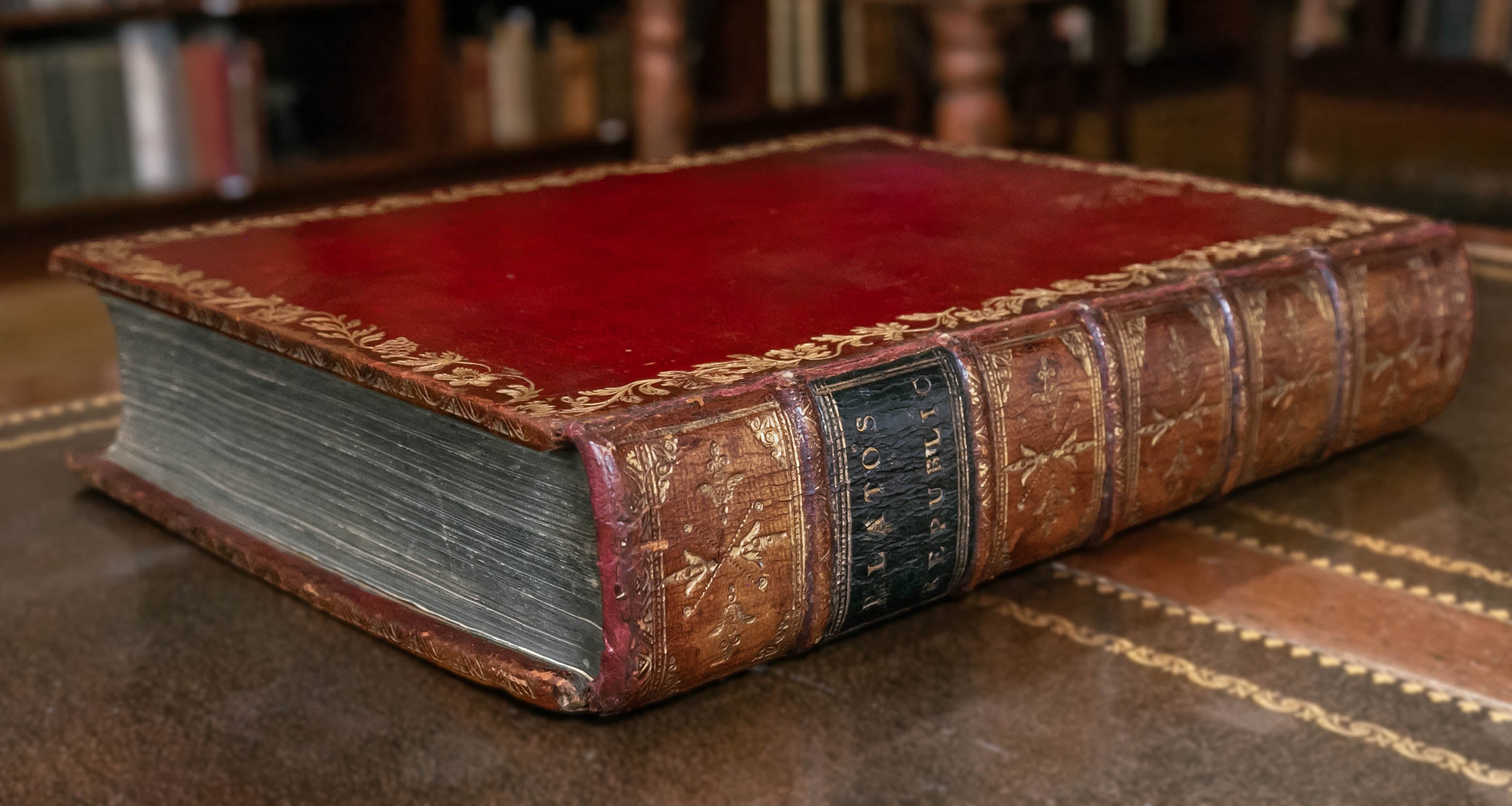
The Republic of Plato (Bound by the Foulis Press Bindery)
Glasgow: Robert & Andrew Foulis, 1763.
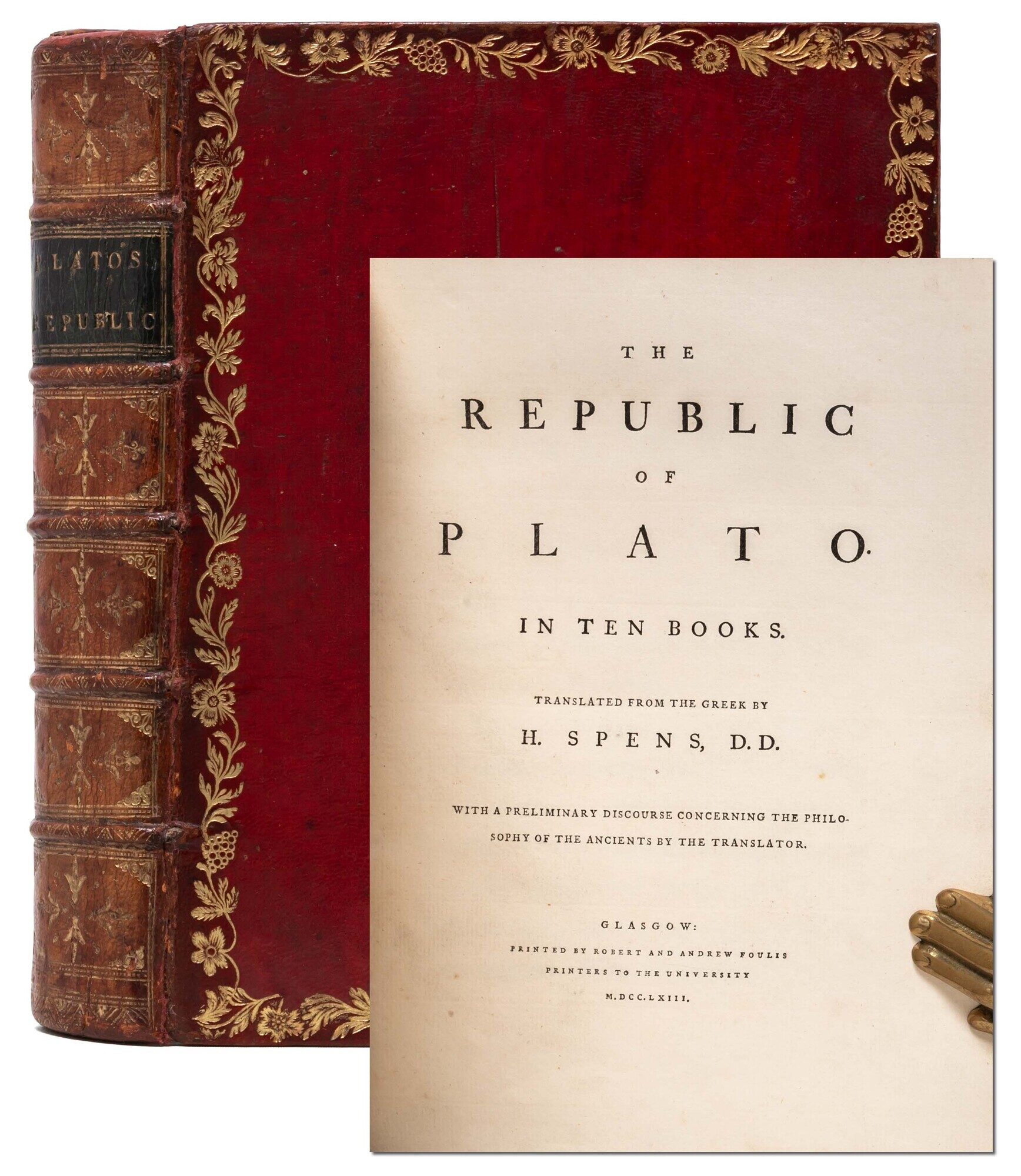
The Republic of Plato (Bound by the Foulis Press Bindery)
Glasgow: Robert & Andrew Foulis, 1763. First edition in English. Translated from the Greek by H. Spens and with his introductory essay. An exceptional copy bound by the Foulis Press Bindery, and rare thus. Quarto (241 x 179 mm, similar leaf size to other copies designated as "large paper" copies). Complete: [4], xl, 430, [2, ads]. An exceptional, Near Fine copy overall. Beautifully bound in full cherry-red turkey morocco with decorative gilt floral borders. Spine in compartments with the cross design described by Philip Gaskell as likely identifying the deluxe Foulis bindings (see The Library, Fifth Series, Volume VII, No. 2). Boards with the same distinctive floral tooling used on the Foulis Press binding of Robert Simson's Opera (Glasgow: Robert and Andrew Foulis, 1776) held at Glasgow University. Edges stained dark green. Binding with some minor repairs to the outer joints. Internal contents generally in fine condition. With the library label of Appuldurcombe House ("App.") to upper pastedown and an ownership inscription, dated June 1776, to upper free endpaper. Extremely scarce and desirable in a deluxe binding executed by the Foulis Press Bindery. Housed in a custom slipcase.
This copy belonged to the politician and antiquary Sir Richard Worsley, 7th Baronet (1751 – 1805), and contains the label of his family's Appuldurcombe House ("App."). The anonymous ownership inscription reveals that Worsley then gifted the copy to a friend: "Given to me at Appuldurcombe, Isle of Wight, June the 7 1776. By my very worthy & amicable Friend Sir Richard Worsley Baronet." It is likely that this copy was specially presented by the Foulis Press to Worsley's father, Thomas (1726 – 1768), sometime around 1763, and passed into Worsley's possession upon his father's death in 1768. If Worsley read Plato in his father's library as a child, as many aristocratic young men would have done at the time, the experience may have inspired his lifelong interest in the classical world. Throughout the 1780s, Worsley traveled in Greece, Italy, Egypt, and Turkey, collecting sculpture, paintings, and gems, which he brought back to Britain and housed at Appuldurcombe. Worsley had, by 1790, assembled the largest collection of classical Greek sculpture in Britain, and had been made a fellow of both the Society of Antiquaries of London and the Royal Society.
The distinctive style of the Foulis Bindery is evident in the binding of this copy: the spine gilt, the floral borders, and the color and type of the leather all match other deluxe bindings done by the press. In The Library, Philip Gaskell describes a matching spine design and color of leather: "It is...hard to establish the identity of any of the better sort of Foulis bindings, since no signed examples have appeared. There is, however, a design, of which the distinctive feature is a series of crosses in the spine panels, which occurs on the well-made calf and morocco bindings of a surprisingly wide range of Foulis books, and which I have seen nowhere else. This observation was first suggested to me by Mr. John Weird of Glasgow University, who showed me several splendid examples in faded cherry-red morocco..." (Gaskell, p. 87). The Glasgow University Special Collections digital exhibit, "Robert & Andrew Foulis, the Foulis Press, and Their Legacy," also notes that Robert Foulis "personally supervised the binding of many of the finer volumes" and "'red turkey gilt'...apparently, was Foulis' favorite binding." Additionally, the exact floral pattern seen on the boards – a bloom, a leaf, and a bunch of grapes – can also be found on a copy of Robert Simson's Opera (Glasgow: Robert and Andrew Foulis, 1776) held in the Glasgow University collections (shelfmark BD12-c.22). Taken together, this evidence indicates that this copy was indeed bound by the Foulis Press Bindery.
First written around 380 BC, The Republic is a work in which Plato explores questions of justice, goodness and truth, and how to order the ideal government and man within it. It is, without a doubt, one of the most influential works of philosophy and political theory ever written, containing immensely consequential ideas like Plato's allegory of the cave and his outline of the five regimes. The ripple of concepts first discussed in The Republic can be followed throughout the course of human political and intellectual development, from classical Greece to the Renaissance and the Enlightenment, as insightful today as it was nearly 2,500 years ago.
"Amidst a great diversity, both of subject and treatment, the dialogues are pervaded by two dominant impulses: a love of truth and a passion for human improvement. While nowhere is a definite system laid down, it has been truly said that the germs of all ideas can be found in Plato" (PMM 27: Plato's Opera, 1484).
Gaskell, Philip. "The Early Work of the Foulis Press and Wilson Foundry." The Library, Fifth Series, Volume VII, No. 2 (June 1952), pp. 77-110.
Smith, Robert Fairfull. "Robert & Andrew Foulis, the Foulis Press, and Their Legacy." Glasgow University Special Collections digital exhibit. Near Fine (Item #8261)