
Satyagraha in South Africa
Triplicane, Madras: S. Ganesan, 1928.
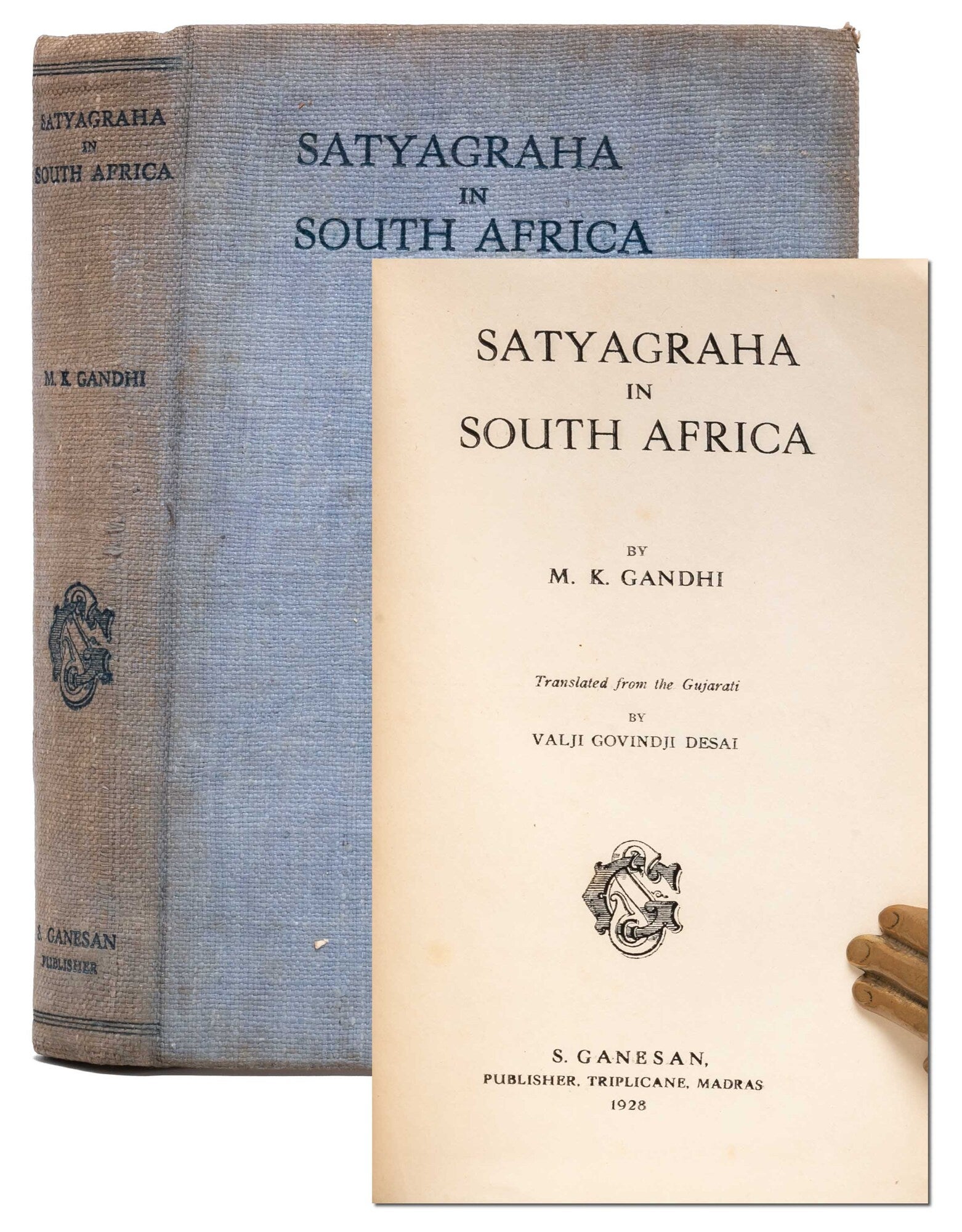
Satyagraha in South Africa
Triplicane, Madras: S. Ganesan, 1928. First edition in English. Translated from the Gujarati by Valji Desai. A Very Good copy. x, 511, viii pp. Publisher's blue cloth titled in blue. Fading and some browning to cloth at spine and edges of boards. Expert tissue reinforcement to inner hinges. Toning to endpapers and to edges of text block, otherwise quite clean throughout.
Gandhi developed and named satyagraha, his nonviolent resistance strategy, in 1906. That year, the Asiatic Registration Act was put into place in the Transvaal Colony, a British-occupied territory in what is now the northwestern part of South Africa. The Act, which is considered a precursor to apartheid, required Indian and Chinese residents to register themselves with the colonial government and carry identification documents at all times, risking arrest and deporation if they did not. The Transvaal Immigrants Restriction Act of 1907 further curtailed the rights of Indian and Chinese residents with immigration bans, literacy tests, and arrests. Gandhi had been living in the Transvaal Colony since 1893, first working as a lawyer and then serving in the Ambulance Corps during the First Boer War. Upon the implementation of the Asiatic Registration Act, Gandhi and his activist allies successfully campaigned for its repeal using nonviolent resistance. Though the Act was re-instated in 1908, the successful campaign demonstrated the effectiveness of satyagraha even against the power of the British Empire.
When Gandhi returned to India in 1915, he brought satyagraha back with him; he and his allies utilized the strategy of satyagraha to destabilize British control of the nation throughout the thirty-year struggle for Indian independence. One notable example was the 1930 Salt Satyagraha (or the Salt March), a twenty-four-day march of over sixty thousand people, and associated acts of civil disobedience including labor and tax strikes. The Salt Satyagraha brought international recognition to the Indian struggle for independence and caught the attention of future American Civil Rights leaders like Martin Luther King Jr., whose own strategy of nonviolent resistance was deeply inspired by satyagraha and Gandhi's movement.
Gandhi wrote Satyagraha in South Africa in the midst of the Indian independence movement – he wrote the first half of the book while in jail after his arrest for protesting – as a history and guide for his fellow believers in satyagraha. In the preface, he writes: "The reader will note South African parallels for all our experiences in the present struggle to date. He will also see from this history that there is so far no ground whatever for despair in the fight that is going on. The only condition of victory is a tenacious adherence to our programme" (p. 6). Very Good (Item #8238)


