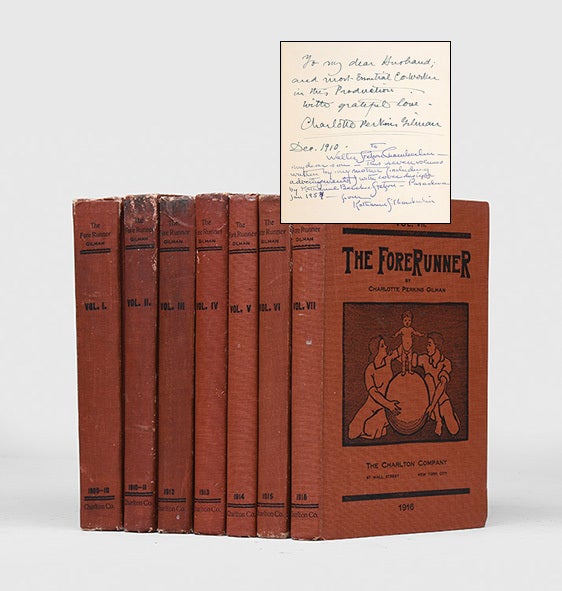
The Forerunner. A Monthly Magazine. (Inscribed Family Association Set (in 7 vols.)
New York: The Charlton Company, 1909-1916.
The Forerunner. A Monthly Magazine. (Inscribed Family Association Set (in 7 vols.)
New York: The Charlton Company, 1909-1916. First edition. [12 sets of 32 pp., plus wrappers]; 7 vols. 8vo. collating complete: [3-338] [4]; 336 [4]; 336 [4]; 336 [4]; 336 [4]; 336 [4]. In publisher's terra cotta cloth, stamped with title and illustration to front board; some signs of wear to bindings, fore-edge of back board slightly chewed away on the first volume.
Inscribed in four volumes by Charlotte Perkins Gilman to her second husband, George Houghton Gilman (1867-1934), additionally, all seven volumes bearing inscriptions by Charlotte's only child, Katharine Beecher Stetson (1885-1979) passing the books along to the author's grandson Walter Stetson Chamberlin (1920-2019) in 1954. Though Charlotte's unhappy first marriage provided inspiration for her infamous feminist short story The Yellow Wallpaper, her second marriage provided the kind of equity and companionship she imagined in her other writing. Notably, Perkins and Houghton founded a publishing company, Charlton, in 1905, to publish her own works, which had had trouble with traditional publishers, who found her work too controversial, and the Forerunner was the first publication under the new imprint. Houghton lent his office for the address of both press and journal, and "his financial aid whenever possible." Katharine, then twenty-four, designed the cover, an image of a family in which the father is supporting the mother and the mother in turn supporting the child, as they support a globe together (Davis 298).
Charlotte wrote all of the material published in The Forerunner (2,400 pages worth, or at least 336 pages a year) for an audience of nearly 1,500 subscribers, whose $1 subscriptions helped subsidize the publication that was otherwise paid for by the Gilmans. As a platform for her editorials, reviews, poetry and fiction, she also wrote novels and released them as serials in this periodical publication. Some of the more famous works that see print in these pages include her feminist utopian trilogy: Moving the Mountain (1911), Herland (1915), and With Her in Ourland (1916). Herland, the most famous of these stories, tells of a group of male sociologists who visit a land of women who reproduce through parthenogenesis and have created a society that is both peaceful and technologically advanced. Other major works printed in The Forerunner include What Diantha Did (1909-1910), The Crux (1911), Man-Made World (1911), Mag-Marjorie (1912), Won Over (1913); and Begnina Machiavelli (1914).
The inscriptions across the volumes are reminders of how the couple's mutual support and respect made these efforts possible. The first volume's inscription by Gilman reads: "To my dear Husband; and most-Essential Co-Worker in this Production with grateful love – Charlotte Perkins Gilman / Dec. 1910". Underneath, her daughter has written: "To Walter Stetson Chamberlain – my dear son – this seven volumes written by my mother (including advertisements) with lovely design by Katharine Beecher Stetson – Pasadena Jan 1954 – from Katharine S. Chamberlain." Volume II is inscribed by Charlotte Perkins Gilman, "Special for a Husband – from a loving wife. Call it Xmas 1910"; Volume III is simply signed by Charlotte Perkins Gilman in New York; and Volume VI is inscribed "For The Husband, still helping it along – from C.P.G."
The first piece in The Forerunner, Vol. 1, No. 1, the poem "Then This," sets the tone for what Gilman hoped the serial to be – a place where ideas too radical for the general publishers could reach an audience: "It strives in prose and verse, / Through, fancy, fact and fun, / To tell the things we ought to know, / To point the way we ought to go, / So audibly to bless and curse, / That he who reads may run." Very Good (Item #5618)